The story behind a 150-year-old mechanical doll that crawls like a real baby
More than 150 years ago, inventors created a toy that still terrifies people today. Its pale face, exposed brass mechanism, and unnatural crawling movements are reminiscent of scenes from a horror film. But the real story behind this Victorian invention is almost as captivating as the legends surrounding it.
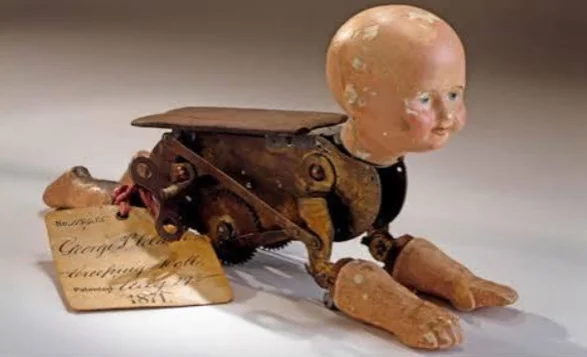
The crawling doll was developed in 1871 by American inventor George Pemberton Clark. His creation dates back to an era when inventors were experimenting with mechanical toys that imitated living creatures.
The doll had a painted plaster head, arms, and legs. Its movements were driven by a hidden clockwork mechanism. Gears connected to the limbs created the illusion of a baby crawling on the floor.
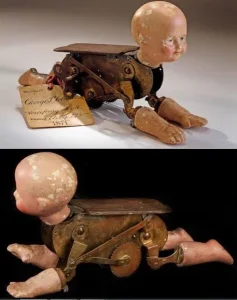
Its design was unusual, even for the Victorian era. Instead of concealing every component, the structure exposed parts of the brass mechanism. Today, this detail makes the antique toy particularly eerie.
The doll’s appearance has changed over time. In surviving images, its original clothing is missing. The pale plaster cast and exposed mechanisms give it an almost skeletal appearance.
There’s something unsettling about a mechanical object imitating a human. A crawling baby should be a familiar sight. But when the movement is driven by gears and metal parts, the effect can seem strangely unnatural.
This contrast helps explain why antique dolls remain popular in horror films. Their human features seem familiar, but their frozen expressions never change. Even an ordinary mechanism can appear ominous when it moves in unexpected ways.
A Horror Film Gave a Doll a Darker Legacy
The doll’s story has taken an even darker turn in popular culture. According to *Popular Science*, the antique toy inspired the little-known 1972 horror film *Miriam: The Killer Clockwork Doll*.
In the film, a group of friends encounter an old, crawling doll. It is speculated that an evil force possesses the toy, turning it into a deadly threat. The story transforms the unusual mechanical invention into an object of supernatural horror.
However, there is no confirmed evidence that the real doll was possessed. Its crawling movements have a mechanical explanation. The idea of possession belongs to the fictional horror narrative, not established historical evidence.
The fascination with mechanical human figures dates back centuries. Inventors have repeatedly attempted to reproduce the movements of living creatures. Yet these creations can evoke more anxiety than admiration.
The Crawling Baby doll reflects this strange contradiction. Conceived as a toy, its appearance now evokes something far more sinister. Its old-fashioned mechanism also reminds us how unfamiliar technology can seem when its workings are revealed.
Perhaps the doll’s greatest secret isn’t supernatural at all. It’s the power of the human imagination to transform an inanimate object into something terrifying. More than 150 years later, this crawling Victorian creation still looks as if it could move when no one is looking.
Based on materials from Popular Science.
It was previously reported that scientists had finally solved the mystery of a 700-year-old skeleton found in Scotland. This skeleton, with horrific injuries reminiscent of a modern car accident, had long been a mystery.