The mystery of a 700-year-old skeleton whose injuries resembled those of a car accident
Imagine a medieval warrior whose bones look like he was plowed down by a freight train or a speeding truck on a modern highway.
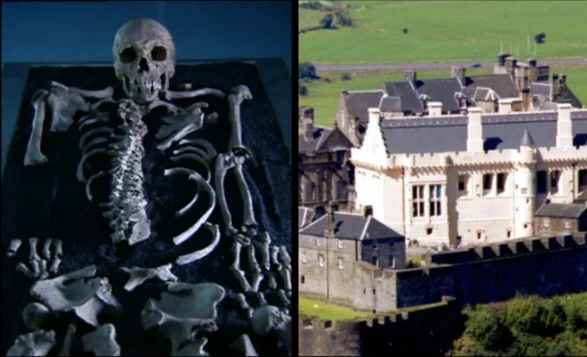
According to a report covered by Popular Science, that’s precisely the puzzle forensic scientists faced when analyzing a 700-year-old skeleton unearthed beneath the floor of a castle chapel in Scotland.
Archaeologists excavating Stirling Castle discovered a mass grave of nine people in the ruined royal chapel. Radiocarbon dating revealed that they died around 1300, during the bloody period when King Edward I of England besieged the fortress.
Most of the bodies bore typical signs of medieval warfare: clean sword slashes, blunt trauma from maces, and fractured limbs from brutal hand-to-hand combat.
Then there was Skeleton No. 150.
This single frame was an absolute crime scene of shattered bone. Researchers counted more than 167 distinct fractures across his body. His skull was splintered into 61 individual fragments. His upper leg bones were completely pulverized, and dozens of strange, zigzagging breaks crisscrossed his ribs and shoulder.
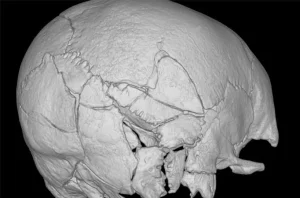
In a recent forensic investigation, experts set out to figure out what could possibly inflict that much kinetic energy on a human body in the 14th century.
Using advanced 3D imaging and bone trauma analysis, they first confirmed that every single break occurred while the man was still alive. Post-mortem crushing under heavy rubble was ruled out.
Next, they compared the fracture patterns against historical accidents. Falls from high castle walls didn’t match the localized crushing. Trampled by runaway horses? Hoof strikes don’t shatter thick leg bones and skulls into dozens of shards simultaneously.
In fact, modern trauma data showed that Skeleton 150’s injuries only had one close modern equivalent: a pedestrian struck head-on by a high-speed vehicle.
The Medieval Equivalent of a Speeding Car
Since automobiles were half a millennium away, the culprits had to be siege engines.
During the siege of Stirling Castle in 1304, English forces spent months bombarding the fortress with massive catapults and giant trebuchets—including the legendary “War Wolf,” arguably the largest trebuchet ever built.
These colossal catapults hurled massive stone projectiles at blinding speeds designed to pulverize stone walls. If a human standing near the ramparts took a direct or near-direct hit from one of those flying boulders, the transfer of kinetic energy would match the impact of a multi-ton car.
Archaeologists now believe Skeleton No. 150 is the first direct, forensically proven victim of a siege engine impact in history. And because his comrades took the time to bury him carefully inside the chapel floor, the siege likely dragged on for weeks after his violent end.
We also previously reported on a mysterious city discovered underwater off the coast of Britain. Archaeologists reported that 700 years ago, this medieval settlement was home to 117 people before it disappeared.