NASA’s year-long experiment simulates life on Mars
Participants in the CHAPEA experiment have been living in a specially sealed module for nearly 365 days, growing plants, conserving resources, and simulating outings to the planet’s surface. They communicated with their families only via email, with a delay simulating communication with Mars.
The experiment is designed to help NASA study how prolonged isolation affects the crew’s health and performance. The participants will leave the module on October 31, after which they will undergo medical examinations and interviews with scientists.
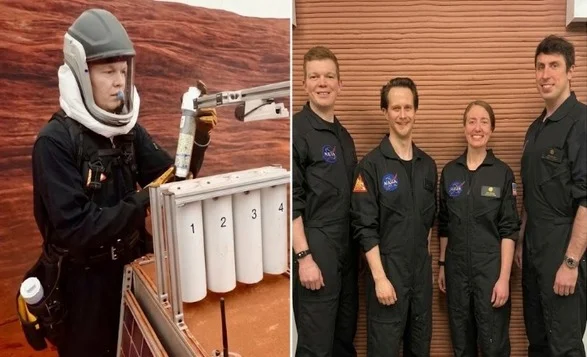
As part of NASA’s CHAPEA 2 mission, four volunteers were placed in a specially designed habitat module at the Johnson Space Center in Houston, Texas. The crew entered the module on October 19, 2025. They are scheduled to exit on October 31, 2026, completing a 378-day simulated mission on Mars.
The habitat module, known as Mars Dune Alpha, occupies approximately 1,700 square feet. Its 3D-printed structure includes living quarters and designated areas for work, exercise, medical care, and food cultivation.
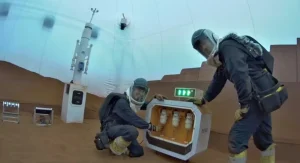
A Year Inside a World Designed to Simulate Mars
The volunteers are Ross Elder, Ellen Ellis, Matthew Montgomery, and James Spicer. Each plays a specific role in the simulated expedition.
Their daily life involves much more than simply staying inside a sealed building. They conduct scientific research, maintain equipment, exercise, and grow crops. They also conduct simulated spacewalks across a specially prepared landscape simulating the Martian surface.
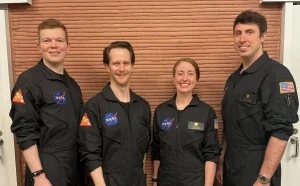
This environment poses practical challenges that future explorers may face. Supplies are limited, equipment can fail, and the crew must manage conflicting tasks without the comforts of Earthly life.
One of the most challenging aspects of a real Mars expedition is the distance separating the astronauts from their families and mission control.
Radio signals cannot travel instantly across the vast space between planets. Depending on their positions, Earth and Mars may experience significant communication delays.
During CHAPEA, messages are delayed to recreate this problem. Crew members communicate with their families via email instead of enjoying unrestricted, instant communication.
At first, these conditions may seem acceptable. However, months of isolation can turn ordinary frustrations into serious problems. Researchers want to understand how isolation affects decision-making, teamwork, health, and performance.
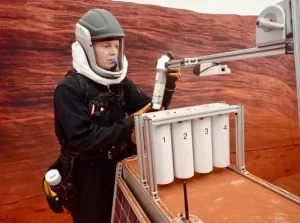
Why NASA Needs to Study Life on Mars
The experiment is not being conducted on Mars. It is a ground-based simulation designed to help scientists prepare for future crewed expeditions.
Researchers will evaluate the information collected throughout the mission. After exiting the habitat, volunteers will undergo a medical examination and in-depth interviews with scientists.
Their experience could help NASA develop more effective procedures for managing food supplies, medical needs, psychological issues, and unexpected equipment failures.
A successful mission to Mars will require more than powerful rockets and modern spacesuits. Astronauts will also have to live together in an isolated environment for extended periods of time, far from immediate assistance available on Earth.
The experiment provides researchers with the opportunity to study these issues before the astronauts embark on the actual journey.
VIDEO. Can We Survive On Mars? | Space Colonies.
The door to the habitation module is scheduled to open on October 31st. For the four volunteers, this will mark the end of an unusual year. However, for NASA, the most important part of the mission may just be beginning: learning what their experiences can reveal about humanity’s future beyond Earth.
It was previously reported that scientists were addressing a new and intriguing question: Could deep sleep help astronauts survive a mission to Mars? Specialists have begun studying this question of deep sleep as a new way to protect against radiation and stress during a future mission to the Red Planet.