Atlantic “Cold Blob” Raises New Climate Concerns
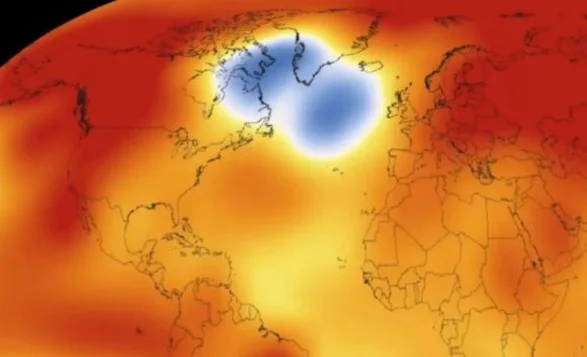
For years, climate researchers have been scratching their heads over a strange area of the North Atlantic Ocean. While almost every ocean on Earth has been warming, one region south of Greenland and Iceland has been doing the exact opposite.
Scientists call it the “cold blob.” On temperature maps, it stands out like a blue stain surrounded by warmer waters. Since the early 1900s, temperatures there have dropped by nearly one degree Celsius, something that shouldn’t be happening in a warming world.
Now researchers believe they finally know what’s behind the mystery. And according to them, the answer may not be good news.
The new study points to a slowdown of the Atlantic Meridional Overturning Circulation, or AMOC. Most people have never heard of it, but this enormous system of ocean currents helps move warm water from the tropics toward the Northern Hemisphere.
You can think of it as a giant conveyor belt operating inside the Atlantic Ocean. Warm water travels north, cools down, sinks and then slowly returns south through deeper layers of the ocean.
The Atlantic Ocean May Be Warning Us About a Bigger Problem
Scientists have argued for years about what causes the cold blob. Some believed changing winds and cloud patterns were responsible. Others suspected that the AMOC itself was weakening. According to the new research, the second explanation appears to fit the evidence much better.
To investigate the mystery, researchers combined satellite observations with ocean measurements collected over many years. What surprised them was that the cooling wasn’t limited to the surface. The same pattern was detected deeper in the ocean as well.
That finding suggests something larger is happening beneath the waves. Many climate scientists believe increasing amounts of freshwater from melting ice in Greenland are interfering with the normal flow of the AMOC. As more freshwater enters the North Atlantic, it becomes harder for cold salty water to sink, weakening the circulation system.
Why does this matter? Because the AMOC helps regulate weather and climate across large parts of the world. If it continues to weaken, the effects could reach far beyond the North Atlantic.
Video. Mysterious North Atlantic Cold Blob Raises Fears Of A Major Ocean Current Collapse | WION Podcast
Previous studies have suggested that a major slowdown could contribute to rising sea levels along parts of the U.S. East Coast, colder winters in Europe and significant shifts in rainfall patterns across Africa and other regions.
Researchers are not saying the system will suddenly shut down tomorrow. However, many now view the cold blob as one of the clearest signs that important changes are already taking place in the Atlantic Ocean.
For now, the mysterious patch of cold water remains under close watch. What happens there over the next few decades could tell scientists a great deal about the future of Earth’s climate system.
Source: CNN
It was previously reported that Swiss scientists have reported an atypical trend in the Earth’s rotation, which has begun to slow faster than expected. They claim this is due to new climate change and the melting of polar ice.