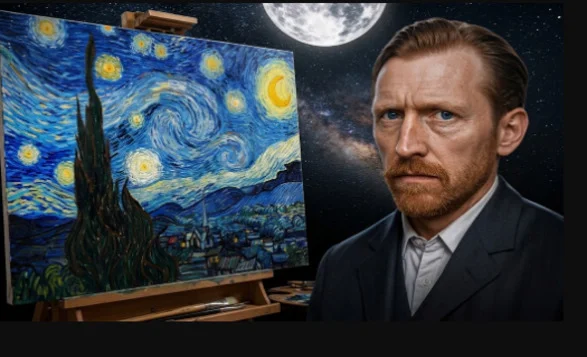
Astronomers Found the Real Date of Van Gogh’s Starry Night
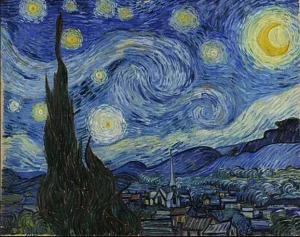
However, fresh astronomical research proves that the painter actually recorded a real cosmic event with astounding accuracy. This amazing study is reported by Scientific Reports.
Scientists reconstructed the night sky above the French asylum back to the early morning of July 1889. On that forgotten night, a razor-thin crescent moon stood beside glowing Venus and the ancient Hyades cluster. Geometric calculations confirmed that Van Gogh immortalized the exact celestial alignment visible just before sunrise on July 22.
Lead researcher Elijah Jeong-hyun Kim spent years untangling the complex mysteries surrounding the world’s most famous canvas. Earlier theories claimed the painted stars represented the constellation Aries, but computational models quickly disproved those assumptions. Kim traveled directly to southern France to trace the painter’s precise steps and exact line of sight.
Sifting through original letters, weather archives, and references to local cicadas, researchers corrected long-standing historical errors.
Traditional timeline theories linked the work to June, but actual lunar phases completely contradicted those earlier dates. By late July, every star and planet on the canvas matched real astronomical records of that summer.
Using advanced point-by-point geometric methods, astronomers matched five central painted stars to the Hyades formation. A subsequent pen sketch by Van Gogh showed an even tighter alignment with the true night sky. Further analysis revealed that stars in his artwork The Night Café secretly depicted the legendary Summer Triangle.
Historical documents show that Van Gogh often spent long hours gazing at the dark horizon in silence. He carefully observed the slow rotation of distant constellations while the rest of the world slept peacefully.
This quiet obsession allowed him to capture subtle astronomical details that casual viewers completely overlooked for generations.
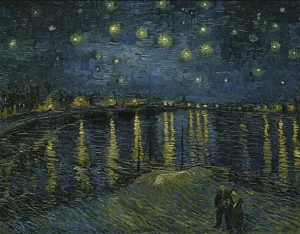
A real horizon painted beneath swirling cosmic shadows
These startling findings prove that Van Gogh was not merely painting wild hallucinations from his isolated room. Instead, he observed the heavens with the laser focus of a seasoned observer watching the universe unfold.
His expressive brushstrokes were grounded in real cosmic mechanics floating far beyond our fragile human world.
The dark hills of Saint-Rémy still whisper secrets of the troubled genius who stared into the void. Van Gogh saw the raw majesty of the cosmos and captured its fleeting light before dawn arrived. Science has finally unlocked his hidden astronomical code, yet the magic of his night remains forever untouched.
VIDEO. Vincent Van Gogh: The Humble Genius.
Now we realize that his masterpiece holds a silent message left across the deep ocean of time. He was not portraying madness, but rather a rare moment of absolute clarity beneath the stars. When morning came, his brush rested, leaving behind a eternal window into a real forgotten night.
Previously, there were reports about the mystery of a painting and world-renowned masterpiece by Raphael, painted by the artist in 1513. Eighty years later, the painting, stolen in Poland by a Nazi general, remains missing and is valued at over $100 million.