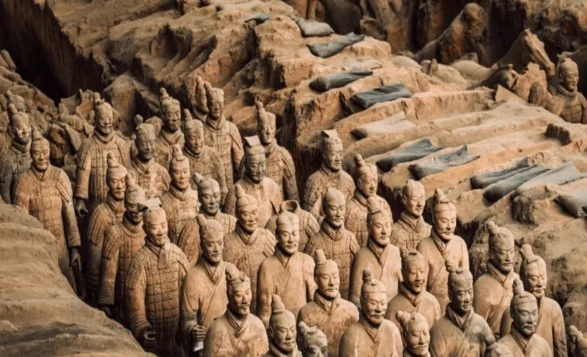
Scientists detect mysterious mercury vapors above China’s first emperor’s tomb, reviving a 2,000-year-old legend
One of the world’s greatest archaeological mysteries may be closer to being solved without moving a single stone. Researchers studying the sealed Qin Shi Huang Mausoleum have detected unusual concentrations of mercury vapor above the ancient burial site.
The discovery adds new weight to a story that has fascinated historians for more than two thousand years. It also suggests that one of China’s oldest legends may be based on real events rather than myth.
The Qin Shi Huang tomb, located near Xi’an in China’s Shaanxi Province, belongs to the country’s first emperor. He united China in 221 BC and ordered the construction of an enormous underground mausoleum. Historical records describe it as one of the largest burial projects ever attempted. Even today, the central burial chamber remains sealed.
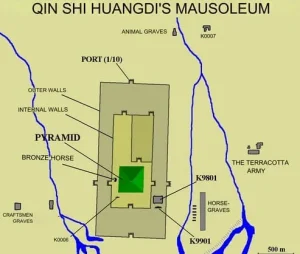
According to the ancient historian Sima Qian, the emperor ordered craftsmen to build rivers, lakes, and seas using liquid mercury. These waterways represented the geography of his empire.
A ceiling decorated with stars completed the underground world. For centuries, many historians believed the account was exaggerated or symbolic. New scientific evidence suggests the story may have been surprisingly accurate.
Scientists recently used a laser-based remote sensing system to measure mercury vapor above the unopened tomb. The equipment collected atmospheric data without entering the burial chamber. This non-invasive approach allowed researchers to investigate the site while leaving the ancient monument completely untouched.
The survey revealed several localized areas where mercury concentrations were much higher than normal background levels. The highest reading reached about 27 nanograms per cubic meter. Even more interesting, the atmospheric anomalies matched locations where previous soil studies had already detected elevated mercury concentrations.
Researchers believe the escaping vapor could be coming from inside the mausoleum. If that is correct, it would provide the strongest scientific evidence yet that large amounts of mercury remain sealed beneath the ground. The findings closely match the ancient descriptions written more than two thousand years ago.
The mausoleum itself remains one of archaeology’s greatest unsolved mysteries. Construction reportedly lasted nearly 38 years. Ancient records claim that as many as 700,000 workers took part in the project. Although the famous Terracotta Army has been excavated, the emperor’s central tomb has never been opened.
VIDEO. Why No One Dares to Open the Largest Tomb in the World. YouTube channel BRIGHT SIDE.
Chinese archaeologists have a good reason for leaving the burial chamber untouched. Opening it today could permanently damage priceless artifacts.
Ancient paintings, wooden objects, fabrics, and lacquerware could begin to deteriorate within hours after exposure to fresh air. Experts believe future technology will allow the tomb to be explored much more safely.
Mercury creates another major challenge. Researchers estimate that roughly one metric ton has escaped into the atmosphere over the past two thousand years. If that represents only one percent of the original amount, more than 100 metric tons could still remain inside the mausoleum. Such quantities would present serious health and environmental risks during any excavation.
Ancient texts also describe automatic crossbows designed to fire at intruders. They mention rare treasures gathered from across the empire and a ceiling that mirrored the night sky. No one knows how accurate every detail is. However, previous discoveries around the mausoleum have shown that many historical accounts were remarkably reliable.
The latest findings demonstrate how quickly archaeology is changing. Instead of breaking into ancient monuments, scientists can now use lasers, remote sensing, and other advanced technologies to study what lies underground. Every new discovery provides valuable clues while protecting priceless cultural heritage.
For now, the Qin Shi Huang Mausoleum continues to guard its secrets beneath the earth. The discovery of unusual mercury vapor suggests the legendary underground rivers may not have been fictional after all.
Whether the tomb will ever be opened remains uncertain. Until then, every new study brings researchers one step closer to solving one of history’s greatest archaeological mysteries.
Source: Daily Galaxy
It was previously reported that archaeologists announced the discovery of an ancient Mayan city. It had been hidden for centuries in the dense jungles of Mexico. Ancient pyramids and temples with ritual stone monuments were discovered within this mysterious ancient city.