SpaceX Rocket to Crash Into the Moon on August 5, 2026
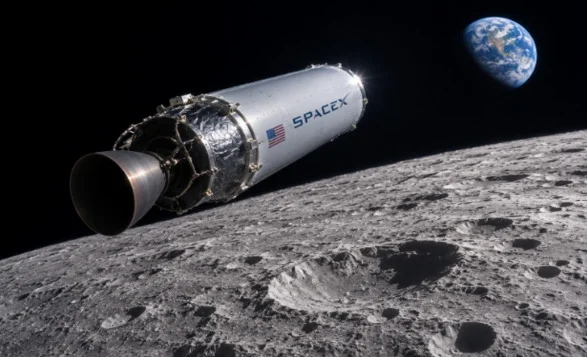
Space is full of surprises, but this one sounds like something straight out of a science fiction movie. On August 5, 2026, a massive Falcon 9 rocket stage launched by SpaceX is expected to crash into the Moon.
The mission it supported ended long ago, yet one piece of the rocket has continued drifting through space. Now its journey is almost over. The object is the upper stage of the Falcon 9 that carried the Blue Ghost and Hakuto-R lunar landers into space in January 2025.
While the reusable first stage landed safely back on Earth, the second stage remained in deep space. It never had enough fuel to return, and it was placed on an orbit that made re-entry into Earth’s atmosphere impossible.
That may not sound incredibly fast by space standards, but it is more than enough to carve a fresh crater into the Moon. The Falcon 9 stage weighs about 4.9 metric tons, making it one of the largest human-made objects expected to hit the Moon in recent years.
Scientists estimate the collision will release energy roughly equal to three tons of TNT. Because the Moon has no atmosphere, there will be no fireball or shockwave like those seen on Earth. Instead, the impact will throw clouds of dust and broken rock high above the lunar surface.
The new crater could reach around 20 meters across. For planetary scientists, that is exciting news. Fresh craters expose underground material that has not been affected by billions of years of space weather. Studying these newly uncovered layers helps researchers better understand the Moon’s history.
The impact is expected to occur near Einstein Crater, close to the edge of the Moon’s visible side. The exact location will be updated shortly before the collision. Tiny gravitational effects from the Earth and the Moon can slightly change the rocket’s final path.
If skies are clear, observatories across North and South America will try to capture the event. The flash will likely be too faint for casual skywatchers, but powerful telescopes equipped with sensitive cameras could record it. Even a few seconds of footage would provide valuable scientific data.
Interestingly, this is not the first time humans have unintentionally or deliberately sent hardware crashing into the Moon.
During the Apollo era, NASA intentionally directed spent rocket stages toward the lunar surface. Their impacts generated seismic waves that instruments left behind by astronauts successfully recorded.
NASA repeated the idea decades later with the LCROSS mission. In 2009, a spacecraft slammed into a permanently shadowed crater near the Moon’s south pole.
The resulting debris cloud confirmed the presence of frozen water beneath the surface. That discovery became one of the most important lunar findings of the century.
The upcoming Falcon 9 Moon impact was never part of the original mission plan. It is simply the result of orbital mechanics. Even so, researchers see it as another rare opportunity to watch a fresh impact happen in real time instead of discovering the crater years later.
The event also highlights a growing challenge for future exploration. More countries and private companies are sending spacecraft toward the Moon than ever before. As traffic in cislunar space increases, tracking abandoned rocket stages and other space debris is becoming increasingly important.
Further reading: NASA – Earth’s Moon. NASA – Moon Facts.
It was previously reported that researchers had discovered a cave on the Moon that could become a future base for astronauts. The cave was detected by radar in the Sea of Tranquility region, the site of the Apollo 11 lunar landing in 1969.