NASA Prepares Rare Mission to Save Swift Telescope From Falling to Earth
NASA is preparing an unusual and somewhat unexpected mission to save the Swift space telescope from losing its orbit. The idea sounds almost old-fashioned at first glance, but it mixes very different generations of technology into one operation.
The Swift observatory has been in space since 2004. It is mainly used to study gamma-ray bursts — extremely powerful explosions that happen far away in the universe. Over time, the spacecraft has slowly been dropping lower because of atmospheric drag.
Engineers now estimate that by mid-2026, the risk of uncontrolled orbital decay could become serious. The problem is simple but critical: Swift was not built with engines to boost itself back into a higher orbit.
To solve this, NASA is working with Katalyst Space, a private aerospace company developing a special docking system called LINK. The idea is that this small spacecraft will connect to Swift and push it into a safer orbit.
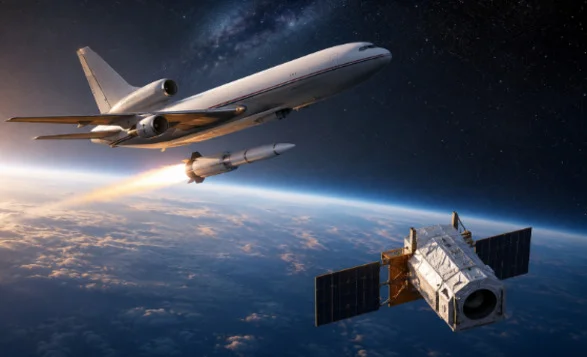
The mission depends on an unusual launch method. Instead of a normal rocket launch from the ground, NASA will use the Pegasus XL, an air-launched rocket system carried under a large aircraft.
Video. NASA’s Swift Mission Gets a Boost.
And that aircraft is the real surprise. It is the Lockheed L-1011 Stargazer, a plane originally built in 1974 as a commercial passenger jet. Decades later, it was converted into a flying launch platform.
It is still in service today. In fact, it remains the only aircraft of its kind actively used to launch rockets into space. Over the years, it has completed dozens of missions, quietly becoming a key part of this niche launch system.
The launch process is unusual. The plane climbs to about 12 kilometers, then releases the rocket. After a short free-fall, the Pegasus XL ignites its engine and continues into orbit on its own.
This method is not just interesting — it is practical. Air launches give more flexibility in choosing orbital paths and reduce some of the fuel limitations of traditional ground launches.
If everything goes as planned, the LINK module will reach Swift and help extend its mission. That would allow the telescope to continue collecting data on some of the most energetic events in the universe.
It is a strange combination: a 1974 aircraft, a modern private spacecraft module, and a NASA telescope that has already worked for more than two decades. But sometimes space missions rely on exactly this kind of unlikely cooperation.
Sources: NASA Swift Mission Update. NASA Press Release on Katalyst Space Mission.
It was previously reported that NASA images released from Mars showed a mysterious pyramid-like object. The mysterious object, about the size of the Great Pyramid of Giza, is located in the Valles Marineris valley on Mars.