Could deep sleep help astronauts survive a mission to Mars?
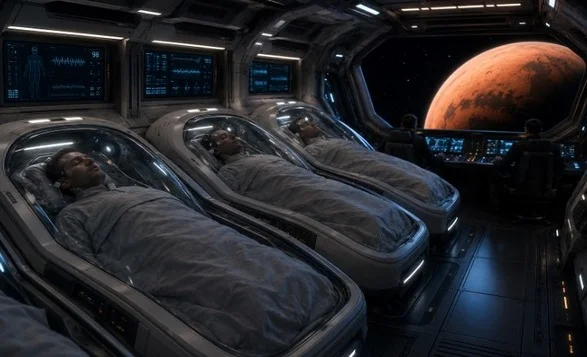
A future mission to Mars could look very different from today’s spaceflights. Instead of spending many months awake inside a spacecraft, astronauts may one day travel in a state similar to hibernation. Researchers believe this approach could reduce health risks, lower mission costs, and make deep-space exploration far more practical.
The idea, once limited to science fiction, is now being investigated by scientists, physicians, and space agencies around the world. Experts hope that understanding how hibernating animals survive for months without food or water could eventually help humans travel safely to the Red Planet.
According to researchers, long-duration spaceflight remains one of the greatest challenges facing future Mars missions. The journey to Mars can take six to nine months using current technology. During that time astronauts face constant exposure to cosmic radiation, muscle loss, bone density reduction, vision changes, and psychological stress caused by prolonged isolation.
Many mammals naturally enter hibernation during periods of extreme cold or food shortages. While hibernating, their metabolism slows dramatically. Heart rate and breathing decrease, body temperature drops, and energy consumption is reduced to a minimum.
Animals can survive for weeks or even months without eating or drinking. Despite remaining inactive for long periods, they experience surprisingly little muscle loss or bone deterioration. Scientists believe these natural biological mechanisms could one day protect astronauts during long interplanetary missions.
Researchers suggest that a controlled state of artificial hibernation could reduce the harmful effects of microgravity. Lower metabolism may also decrease oxygen consumption and reduce the amount of food, water, and medical supplies required onboard a spacecraft.
A smaller demand for life-support resources would reduce spacecraft mass. That could significantly lower mission costs and make future Mars expeditions more efficient.
Scientists also believe that sleeping through much of the journey could lessen the psychological strain of spending many months inside a confined spacecraft. Isolation, stress, and limited personal space remain major concerns for crews traveling far beyond Earth.
Could We Hibernate All the Way to Mars? Video YouTube channel SciShow.
Scientists are studying how to induce human hibernation
Humans do not naturally hibernate. Unlike bears, bats, or ground squirrels, the human body cannot significantly slow its metabolism for long periods. Because of this, researchers are trying to understand the biological mechanisms that allow other species to enter and safely leave hibernation.
One area receiving special attention is the brain. Scientists have identified a region known as the subfornical organ (SFO), which appears to regulate thirst during hibernation. Experiments suggest that certain signaling molecules can suppress the desire to drink for extended periods. Interestingly, humans also possess this same brain structure.
Research teams are now investigating whether medications, ultrasound stimulation, or other medical techniques could safely trigger a temporary state known as torpor. Unlike true hibernation, torpor usually lasts only a few hours or days. However, many experts believe it could become the first practical step toward longer periods of suspended metabolism.
The European Space Agency (ESA) and several research institutions continue to study how hibernating animals protect their organs, muscles, bones, and brains during extended inactivity. Understanding these mechanisms may eventually help doctors develop new treatments for patients on Earth as well.
Artificial hibernation could also have medical applications beyond space exploration. It may improve emergency care after severe injuries, increase survival during major surgeries, and help preserve organs for transplantation.
Although the technology is still experimental, scientists believe the concept is becoming increasingly realistic. If future studies prove successful, human hibernation could become one of the most important breakthroughs in the history of space exploration. It may allow astronauts to travel safely to Mars and, one day, even farther into the Solar System.
Sources: The Guardian – Can humans hibernate their way to Mars?. European Space Agency (ESA) – Hibernation and Torpor research program.
It was previously reported that a nuclear power plant for a mission to Mars could be assembled directly in orbit. Scientists have developed a nuclear engine that will be assembled by robots directly in space.