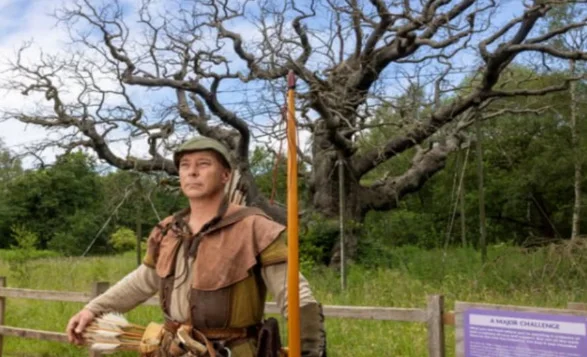
Legendary Robin Hood Oak Dies After 1,200 Years
One of Britain’s most famous trees has reached the end of its remarkable life. The legendary Major Oak, better known as the Robin Hood Oak, has officially died after failing to produce new leaves for the first time in its long history.
For generations, visitors have traveled to Sherwood Forest to see the enormous oak linked to the legend of Robin Hood. Whether the famous outlaw ever stood beneath its branches remains unknown. Even so, the tree became one of England’s best-known natural landmarks.
This spring, conservationists finally accepted what many had feared. The ancient oak never came back to life after winter. No fresh foliage appeared, confirming that the tree had reached the end of its natural lifespan.
According to the Royal Society for the Protection of Birds (RSPB), the oak was around 1,200 years old. That means it was already centuries old before the Robin Hood stories first appeared in English folklore.
Sherwood Forest’s 1,200-Year-Old Major Oak Tree Dies | GRAVITAS. Video YouTube channel WION.
The End of a Living Symbol of Sherwood Forest
The tree was enormous. Its crown stretched almost 28 meters across, while the trunk measured roughly 11 meters around. Standing beneath it, visitors often described feeling as if they were inside a natural cathedral.
Its age also meant constant care was needed. Engineers installed supports beneath several heavy branches more than a hundred years ago. Protective fencing followed in the 1970s after concerns that thousands of visitors were damaging the roots by walking too close.
Experts believe the oak had been weakening for years. Then came a series of unusually hot and dry summers. Those harsh conditions placed additional stress on an already aging tree and likely accelerated its decline.
Even though the Major Oak is now biologically dead, it will not be cut down.
Conservationists say the tree still has an important role to play. Dead ancient oaks provide food and shelter for insects, birds, fungi and many other organisms. In some cases, they continue supporting wildlife for decades after they stop growing.
The loss of the Robin Hood Oak is about more than a single tree. It represents the passing of a living witness to British history. The oak survived medieval kingdoms, civil wars, industrialization and two world wars before finally reaching the end of its life.
Researchers also value trees like the Major Oak for another reason. Ancient oaks preserve clues about past climates in their wood. Scientists use those records to better understand how forests have changed over hundreds of years.
Although the famous tree will never grow leaves again, its story is far from over. Visitors will still be able to see the legendary oak in Sherwood Forest, where it will remain a symbol of Robin Hood and one of Britain’s most recognizable natural treasures.
It was previously reported that, according to the latest statements from experts, the crater in Turkmenistan, known as the “Gates of Hell,” is slowly disappearing after 50 years.