“Gates of Hell” Crater in Turkmenistan Is Slowly Fading but Still Burning
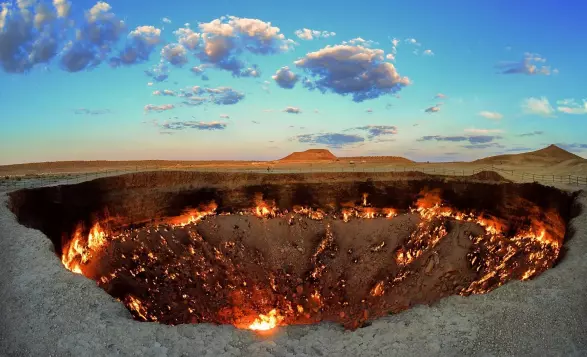
The Darvaza gas crater, widely known as the “Gates of Hell” in Turkmenistan, is no longer burning as intensely as before. Located in the Karakum Desert, the site has been on fire since 1971, but recent data suggests the flames are slowly weakening.
There is no single clear reason. Reports point to reduced gas flow underground, which means less fuel feeding the fire. At the same time, some experts note the reservoir may have been declining naturally for years.
The crater formed after a drilling accident when a large gas pocket collapsed. Engineers set it on fire to prevent toxic emissions, expecting a short burn. Instead, it continued for decades.
Why the “Gates of Hell” Crater Is Losing Intensity After Decades of Burning
New wells drilled near the area appear to have lowered pressure in the gas field. Less pressure — less gas reaching the surface. The effect is gradual, not sudden. Satellite observations confirm lower heat levels, although the exact timing of the decline is still debated.
The Darvaza crater remains a source of methane emissions, and that part is often overlooked when talking about the fire itself. In some periods, output exceeded 1,000 kilograms per hour, which is a significant amount for a single location.
Methane traps heat much more effectively than carbon dioxide, so even a slow, continuous release can have a noticeable impact over time, especially if it continues for years without major changes.
If the fire stops completely, methane may be released directly instead of burning into carbon dioxide. That could increase the overall environmental impact rather than reduce it.
For now, the Gates of Hell are still active, but clearly weaker than before. Whether the Darvaza gas crater will fully go out or continue at a lower level remains uncertain.
Video. Darvaza Gas Crater: The Door To Hell.
What happens next depends on several factors — how much gas is left underground, how active nearby extraction continues to be, and whether any additional measures are taken in the region.
Even small changes in pressure or flow could affect the crater over time, so the situation may keep shifting rather than ending suddenly. In that sense, the site is no longer a constant, but something that is slowly changing.
Sources: IFL Science
We previously reported that in early spring 2026, after several years of relative calm, two new sightings of the legendary monster, affectionately known as Nessie, were recorded in Loch Ness.