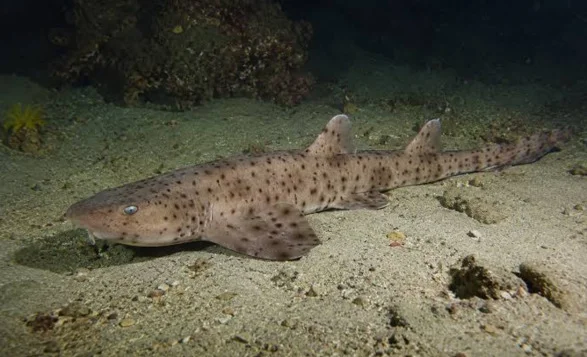
New Walking Shark Species Discovered in New Guinea
Finding a new shark species is already a rare event. Finding one that can literally “walk” across the ocean floor is even more unusual. That is exactly what researchers have reported after studying shallow coastal waters near New Guinea.
The newly identified animal has been named Hemiscyllium dugeonae. The description was published in the Journal of the Ocean Science Foundation. Scientists chose the name to honor marine biologist Christine Dudgeon for her contribution to shark research.
At first glance, the animal looks like a small reef shark. But once it reaches the seabed, it behaves very differently from what most people would expect.
Instead of swimming all the time, the walking shark pushes itself forward with its pectoral and pelvic fins. The movement almost resembles a slow crawl. This allows the shark to travel through coral reefs, rocky bottoms and very shallow water where larger predators often struggle to move.
A Shark That Walks Instead of Swims
Researchers say the species usually lives at depths of less than ten meters. During low tide, some reef areas become extremely shallow. The shark’s unusual way of moving helps it continue searching for food even when there is very little water.
Adult animals grow to about 80 centimeters long. Their bodies are covered with brown spots and lighter markings. These patterns help them disappear against the coral. Scientists also noticed an eye-shaped marking on the head. It may confuse predators for a few crucial seconds.
DNA analysis confirmed that Hemiscyllium dugeonae belongs to the family of walking sharks. This is a small group of reef sharks found only in parts of the Pacific and nearby seas.
Unlike great white sharks or tiger sharks, these animals pose no danger to people. They spend most of their time looking for crabs, shrimp, worms, small fish and other creatures hiding among the reefs.
Marine biologists believe discoveries like this are becoming more common because remote reef systems have never been fully explored. Every expedition brings scientists to places where previously unknown species may still exist.
The discovery is exciting, but it also raises concerns. The shark appears to live in a relatively small area. That makes it more vulnerable if its habitat begins to change.
Coral reefs around the world are already under pressure from climate change, rising ocean temperatures and pollution. If these ecosystems continue to decline, species with such a limited range could disappear much faster than scientists expected.
Researchers now plan to study the shark’s population in greater detail. If its numbers turn out to be low, Hemiscyllium dugeonae could eventually receive international protection. Scientists hope that will help preserve one of the ocean’s most unusual recent discoveries.
Another new discovery was previously reported. Scientists discovered approximately 1,100 new species of marine life, including a ghost shark and other strange creatures.