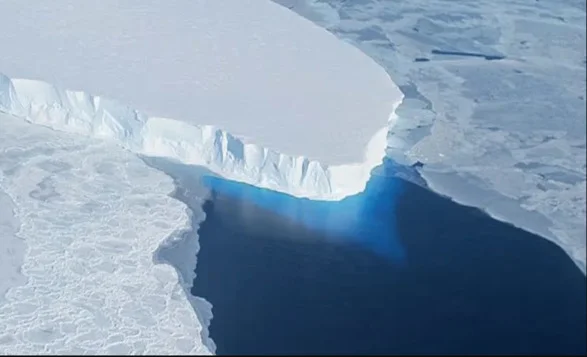
Doomsday Glacier Could Double Sea-Level Rise Estimates
What makes this giant so unpredictable is not just what is happening on its surface, but a hidden mechanism grinding away far below the frozen crust. The Daily Mail reports this.
For years, climate models relied on a simplified picture of where grounded ice meets the ocean, viewing it as a sharp, static border. However, research published in Nature Communications in October 2026 shatters that assumption.
Advanced computer modeling combined with three decades of satellite tracking reveals a far more insidious reality: warm ocean water penetrates several kilometers directly beneath the glacier.
This creates a hidden, shifting zone of rapid sub-glacial melting. As warm seawater quietly carves away at the glacier’s underbelly, it severs the ice from the underlying bedrock.
By factoring in this overlooked mechanism, scientists found a startling match with real-world observations. The projections suggest Thwaites alone could add up to 30 millimeters to global sea levels by 2100—roughly twice the previous average estimates.
VIDEO. Antarctica’s Doomsday Glacier Just Got a New Warning for Britain.
A Tipping Point Hidden in the Shadows
Even more unsettling is a critical threshold identified by the models. As early as 2038, Thwaites could lose grip on a key ridge along the seabed that currently acts as its natural anchor. Unmoored from this underwater barrier, the ice mass would be free to retreat at an accelerated pace.
While 2038 represents a calculated projection rather than an absolute deadline, the implications are staggering. Thwaites holds enough ice on its own to raise global seas by 65 centimeters. Should it destabilize, it could drag neighboring sectors of the West Antarctic Ice Sheet along with it, setting off a domino effect across coastal lines worldwide.
The true danger of the Doomsday Glacier isn’t an overnight deluge, but the invisible, relentless force working in total darkness. Deep underground, warm ocean currents are quietly rewriting the future of our planet’s coastlines.
It was previously reported that scientists had been unable to solve the mystery and explain the enigmatic blood waterfalls in Antarctica for over a century, until a new discovery revealed the truth.