Scientists Finally Explain Antarctica’s Blood Falls Mystery
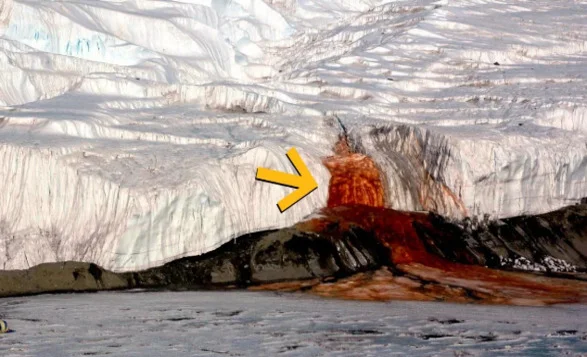
One of Antarctica’s strangest natural wonders has revealed another long-hidden secret. Scientists have, for the first time, explained how the famous Blood Falls periodically release iron-rich red water. The ancient brine has remained trapped beneath the ice for about 1.5 million years.
Blood Falls is located at Taylor Glacier in East Antarctica. The site has fascinated researchers for more than a century because bright red water occasionally flows from the glacier. The unusual stream makes the ice appear to bleed. Scientists already knew why the water was red. Until now, however, they did not fully understand how the ancient brine escaped from deep beneath the glacier.
A research team has now provided the clearest explanation yet. The findings were published in Antarctic Science. The study is based on a rare event recorded in September 2018. GPS receivers, video cameras and temperature sensors all captured data at the exact moment the red water emerged.
Scientists compared information from all three monitoring systems. The combined data allowed them to reconstruct what happened beneath the glacier with far greater accuracy than before.
As the discharge began, the glacier’s surface dropped by about 15 millimeters (0.6 inches). Researchers also measured a temporary slowdown of nearly 10 percent. Those changes show that pressure inside the hidden brine system directly affects the movement of the overlying ice.
The study suggests that the ancient liquid slowly builds pressure beneath Taylor Glacier. Once that pressure reaches a critical level, the concentrated brine forces its way through cracks in the ice. It then reaches the surface. After the pressure is released, part of the glacier briefly settles before gradually returning to normal.
The Mystery of Blood Falls in Antarctica | Science Explained. Arihant Online Academy YouTube Channel
Hidden Antarctic Lake Could Help Scientists Search for Life Beyond Earth
The source of Blood Falls is an isolated subglacial reservoir. It became sealed beneath Antarctica’s ice about 1.5 million years ago. Since then, the water has remained completely cut off from sunlight and atmospheric oxygen. Scientists consider it one of Earth’s most unusual natural environments.
Despite those extreme conditions, the underground lake still supports life. Researchers have identified microorganisms that survive without sunlight. Instead, they obtain energy through chemical reactions involving dissolved iron and sulfur compounds.
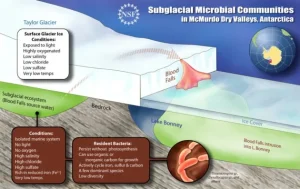
The striking red color appears only after the brine reaches open air. Dissolved iron reacts with oxygen and rapidly forms iron oxide. That chemical reaction gives the flowing water its distinctive blood-red appearance.
Researchers believe this hidden ecosystem provides a rare opportunity to study life in complete darkness. The findings may also improve understanding of conditions that existed on the early Earth before oxygen became abundant in the atmosphere.
The discovery has attracted attention beyond Antarctic research. Planetary scientists believe similar reservoirs could exist beneath thick ice on other worlds. Jupiter’s moon Europa and Saturn’s moon Enceladus are both believed to hide vast oceans beneath their frozen surfaces.
If microorganisms can survive beneath Antarctica’s glaciers for more than a million years, similar forms of life could also exist in extraterrestrial oceans. Those environments are protected from radiation, extreme temperatures and other harsh surface conditions. For that reason, Blood Falls has become an important natural laboratory for both glaciology and astrobiology.
The research team plans to continue monitoring Taylor Glacier. Scientists hope to record additional discharge events in the future. Every new observation could improve understanding of how subglacial water moves beneath Antarctic ice. It could also reveal how isolated microbial ecosystems survive over geological timescales.
Source: Science Alert. Glacier surface lowering and subglacial outflow coincide with Blood Falls discharge in the McMurdo Dry Valleys. Cambridge University Press.