Scientists identify a new giant dinosaur species from fossils discovered by fishermen in Uruguay
A pair of fossil bones discovered by local fishermen has led to one of Uruguay’s most important paleontological finds. After decades of research, scientists confirmed the remains belonged to a previously unknown dinosaur species. The giant animal lived more than 80 million years ago during the Late Cretaceous.
The new dinosaur has been named Mesetasaurus protector. The discovery was made by paleontologists from the University of the Republic of Uruguay. They believe the fossil could change what researchers know about the country’s prehistoric past.
The story began in the 1980s. Two fishermen independently found fossilized tail vertebrae in the same region. One donated his discovery to a local school. The other kept the fossil at home for many years.
Neither man realized the scientific importance of the bones. Only decades later did both fossils reach specialists. After comparing the specimens, researchers concluded they belonged to the same dinosaur.
A forgotten fossil becomes a major dinosaur discovery
The fossilized vertebrae immediately attracted attention because of their unusual anatomy. Scientists found a distinctive depression positioned much closer to the joint surface than in other known dinosaurs from the region. This unique feature allowed researchers to identify an entirely new dinosaur species.
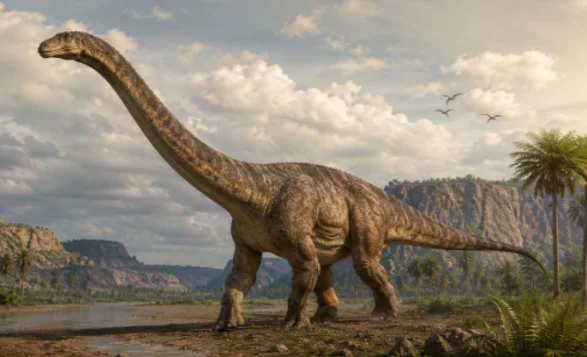
Based on the preserved bones, scientists estimate that Mesetasaurus protector reached a length of between 9 and 10 meters (30–33 feet). Like other titanosaurs, it probably walked on four powerful legs. It also had a long neck and tail. The giant herbivore fed on the vegetation that covered ancient South America.
Researchers chose the name protector in honor of José Artigas, Uruguay’s national hero and one of the leading figures in the struggle for Latin American independence. The name connects the country’s prehistoric heritage with its national history.
The discovery is especially significant because Mesetasaurus protector is only the second dinosaur species formally described in Uruguay. The first was Udelartitan celeste. Until recently, Uruguay remained one of the least explored countries in South America for dinosaur fossils.
Neighboring Argentina and Brazil have produced hundreds of important dinosaur discoveries. Uruguay, however, has received much less scientific attention. Because of this, many paleontologists believe the country still hides numerous prehistoric species waiting to be discovered.
Every new dinosaur fossil helps researchers better understand Gondwana, the ancient southern supercontinent that once included South America, Africa, Antarctica, Australia, and India. Fossils from this period also reveal how giant dinosaurs evolved and adapted before their extinction about 66 million years ago.
Perhaps the most remarkable part of the story is that these fossils spent nearly 30 years outside museums. One vertebra remained in a school classroom. The other stayed in a private collection. At first, they appeared to be nothing more than unusual rocks.
Today, those forgotten bones have become one of Uruguay’s most valuable dinosaur discoveries. The find is a reminder that even fossils overlooked for decades can still transform our understanding of prehistoric life.
Scientists hope similar discoveries will encourage more people to report unusual fossils instead of leaving them hidden in private collections.
It was previously reported that archaeologists had discovered approximately 100 dinosaur eggs in France. The eggs were found at the Dinosaur Museum and Park. According to preliminary estimates, they may be around 72 million years old.