Astronomers Baffled by Planet Orbiting Backward: GJ 3090 b
Space usually follows a pretty strict set of cosmic traffic laws. When a star is born from a swirling cloud of gas and dust, everything in its neighborhood is supposed to spin in the exact same direction. Our Solar System is a perfect example: all eight planets circle the Sun in sync, tilted by just a few tiny degrees.
A newly discovered world located 73 light-years away just spat in the face of those laws. The study was published in the journal Astronomy & Astrophysics, writes Space.
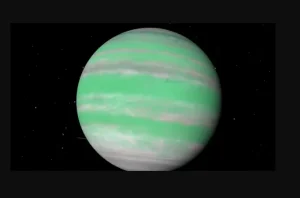
Meet GJ 3090 b, a sub-Neptune roughly twice the size of Earth and 4.5 times its mass. On paper, it sounds like an average planet orbiting a standard red dwarf star. But when astronomers mapped its trajectory, they realized something was deeply wrong: the planet is literally moving backward.
Not only is GJ 3090 b stuck in a retrograde orbit—meaning it circles its star in the opposite direction of the star’s own rotation—but its path is tilted at a mind-bending 136-degree angle.
In planetary science, a tilt over 70 degrees is almost unheard of. In the rare cases where it does happen elsewhere in the Milky Way, there is always a massive culprit nearby—like a heavy gas giant or a companion star—whose gravitational pull dragged the planet out of alignment.
Here is where the story gets weird: the GJ 3090 system has no such bully.
Scientists scanned the surrounding space for a massive neighbor that could have caused this gravitational chaos, but came up empty-handed. The study, recently published in Astronomy & Astrophysics, leaves researchers completely stumped as to how a planet could end up in such a bizarre orbit completely on its own.
Without a giant neighbor to blame, astronomers are forced to consider far wilder scenarios. One leading theory suggests the star might have formed with two separate protoplanetary disks during its infancy—a main disk and a secondary, rogue disk spinning in the opposite direction at a wild angle. If GJ 3090 b was born inside that second chaotic disk, it would explain why it’s running against the cosmic tide today.
For now, GJ 3090 b stands as one of the most puzzling exoplanets ever detected—a lonely world quietly defying everything we thought we knew about how solar systems are born.
It was previously reported that our Earth has also mysteriously begun to change shape. Scientists have discovered that our planet’s shape is constantly changing under the influence of various factors.