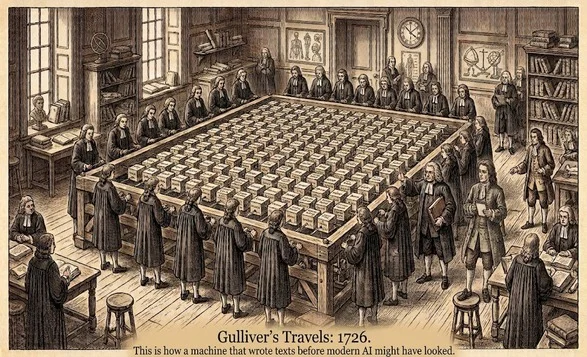
A strange typewriter from the 1726 novel Gulliver’s Travels
A mysterious passage hidden in a classic novel has taken on a chilling new meaning in our high-tech age. Written three centuries ago, the text describes a mysterious machine that generates written material without human talent. The fictional device sounds shockingly similar to the artificial intelligence algorithms powering modern chatbots.
This uncanny invention appears in Gulliver’s Travels, published by Jonathan Swift in 1726.Most readers recall the famous tale for its tiny Lilliputians and oversized giants. However, one forgotten chapter seems to predict the future of digital computing with disturbing accuracy. During his strange journey, explorer Lemuel Gulliver visits the Great Academy of Lagado.
There, eccentric inventors pursue extraordinary technological projects with almost no practical real-world benefit.Among these strange creations sits a massive wooden frame designed to automatically write books on any subject. The contraption consists of wooden blocks, iron wires, and thousands of randomly scattered words.
Students continuously turn small handles around the frame to shuffle the vocabulary into endless new patterns. Scribes then carefully examine the output, recording every meaningful phrase created by these random mechanical combinations.
The machine had no actual understanding of the language it produced. It simply reshuffled vocabulary, leaving humans to guess whether the resulting sentences made sense.
Today, tech analysts draw striking parallels between this 1726 invention and modern artificial intelligence. Language models can draft convincing essays and imitate human writing styles effortlessly. Yet, like Swift’s fictional engine, AI frequently generates completely false information with absolute confidence. The satire raises a timeless question about whether machines can produce language without true comprehension.
Swift’s prophetic novel contains another disturbing detail that continues to baffle astronomers worldwide.
The author accurately described two small moons orbiting around the planet Mars long before official discovery. Astronomers would not identify Phobos and Deimos until 1877, more than 150 years after the novel appeared.
While scientists view this astronomical detail as an educated guess, the uncanny coincidence remains deeply unsettling. Swift imagined endless automated text, ambitious inventors demanding funds, and convincing machines lacking true wisdom. His 18th-century satire raises a haunting question that still lingers today: when algorithms speak, who really understands?
Source of information: IFLScience; Jonathan Swift’s Gulliver’s Travels.
It was previously reported that after more than 400 years of mystery and enigma, scientists have finally determined the exact location of William Shakespeare’s London home. Historians have long known that Shakespeare purchased the property in 1613, but the building’s exact coordinates remained unknown.