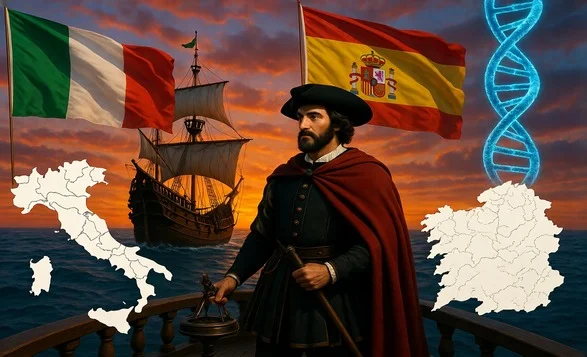
DNA Christopher Columbus Study Reopens Birthplace Debate
Christopher Columbus has been connected with Genoa, Italy, for centuries. Most history books describe him as the son of a simple family from the Genoese Republic. Later, he became one of the most famous explorers in history.
But a new study from Spain is once again raising doubts about that story.
Researchers from the Complutense University of Madrid recently carried out DNA analysis connected to people believed to be descendants of Columbus. After comparing genetic data, the team said there may be a link between the explorer and a noble family from Galicia in northwestern Spain.
The work was based on remains found inside the crypt of the Counts of Gelves. Historians have known for years that several descendants of Columbus were buried there. That made the site important for genetic research.
Scientists examined 12 individuals from the crypt and compared thousands of DNA markers with the help of computer modeling. According to the study, one possible family connection stood out more than the others.
The researchers believe the results point toward the Sotomayor family. This noble house had major influence in medieval Galicia. During the 15th century, the family was involved in political conflicts, military campaigns, and regional power struggles.
One historical figure became central to the investigation. It was Pedro Álvarez de Sotomayor, also known as Pedro Madruga. Historians describe him as an influential Galician nobleman. His life has been surrounded by speculation for decades.
The DNA study focused closely on two individuals buried inside the Gelves crypt. One was Jorge Alberto de Portugal, the third Count of Gelves. His connection to Columbus had already been documented in historical records.
The second was Maria de Castro Giron de Portugal, a member of an aristocratic Galician family. Historians had not directly connected the two through written evidence. However, scientists found genetic similarities suggesting they may have shared the same ancestral line.
Researchers used more than 10,000 genetic markers during the analysis. After tracing family relationships across approximately 16 generations, the team concluded that Pedro Madruga was the most likely common ancestor.
VIDEO. Columbus’s DNA Exposed a 500-Year Lie. No One Was Ready for This.
Why Historians Still Disagree About Columbus’s Birthplace
The idea that Columbus came from Genoa mainly comes from his 1498 will. In that document, Genoa is mentioned as his birthplace. For many historians, this became the strongest argument supporting the Italian origin theory.
Still, questions about Columbus’s background never fully disappeared.
Some experts have pointed to the fact that Columbus mostly wrote in Castilian Spanish. He rarely used Italian dialects common in Genoa during that period. Others believe he may have hidden details about his identity for political reasons while working closely with the Spanish crown.
There have also been theories suggesting Columbus came from a noble background instead of a poor merchant family. Until recently, most of those ideas relied more on historical interpretation than scientific evidence.
The latest DNA findings do not completely settle the debate, but they add another piece to a mystery historians have discussed for generations. Researchers involved in the project say more studies and additional genetic testing will likely be needed.
The story has attracted attention far beyond academic circles because it combines modern science with one of history’s oldest unanswered questions. Even after more than 500 years, interest in Christopher Columbus and his real origins continues to grow.
Source: Euronews — Galician genes: New study suggests Christopher Columbus was from Spanish nobility. CRBC News — Genetic Study Points to Galician Noble Lineage for Christopher Columbus.
We previously reported on another scientific discovery. It was revealed that Adolf Hitler had Kallmann syndrome and a micropenis. DNA analysis revealed a rare genetic disorder that delayed Hitler’s puberty.