Asteroid 2026 JH2 to Pass Close to Earth Safely
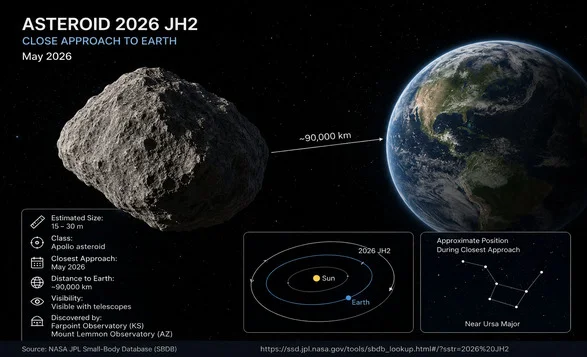
A newly discovered asteroid 2026 JH2 is expected to make a close approach to Earth in the coming days. According to astronomers, the object will pass at a distance of approximately 90,000 kilometers from our planet.
The asteroid was discovered by scientists working at several observatories, including Farpoint Observatory in Kansas and Mount Lemmon Observatory in Arizona. Since the discovery, experts have continued tracking the object to calculate its exact orbit and speed.
NASA’s Jet Propulsion Laboratory estimates that asteroid 2026 JH2 measures between 15 and 30 meters wide. Scientists based these calculations on the asteroid’s brightness and the amount of sunlight reflected from its surface.
Although the asteroid is relatively small compared to larger near-Earth objects, it still attracts significant scientific interest. Researchers use these flybys to improve asteroid detection systems and planetary defense technologies.
Is Asteroid 2026 JH2 Dangerous?
Current calculations show that there is no risk of collision with Earth. Astronomers confirmed that asteroid 2026 JH2 will safely pass by the planet without posing any threat.
The object belongs to the Apollo asteroid class. These asteroids have orbits that cross Earth’s orbital path around the Sun. Because of this, NASA constantly monitors them for any possible future risks.
During its closest approach, asteroid 2026 JH2 is expected to appear near the constellation Ursa Major. The object will likely only be visible through telescopes because it is too faint for naked-eye observation.
Amateur astronomers with small telescopes may still be able to observe the asteroid moving across the night sky. Experts say that close asteroid flybys like this happen regularly throughout the year.
NASA and other international space agencies continuously monitor near-Earth objects (NEOs). Advanced telescopes and automated tracking systems help scientists identify potentially hazardous asteroids long before they come close to Earth.
Studying asteroids also helps researchers learn more about the origins of the Solar System. Many asteroids contain ancient material that has remained mostly unchanged for billions of years.
The close approach of asteroid 2026 JH2 demonstrates why global space monitoring programs are essential. Even though this asteroid is not dangerous, every newly discovered object provides valuable data for future research.
Scientists will continue observing asteroid 2026 JH2 as it travels through the inner Solar System. Updated orbital data may also help improve future asteroid prediction models.
You can check the official NASA JPL Small-Body Database for asteroid 2026 JH2.
We previously reported on a mysterious incident over Hawaii. A local resident saw a mysterious green glow in the night sky. This glow was invisible to the human eye, only to video cameras.