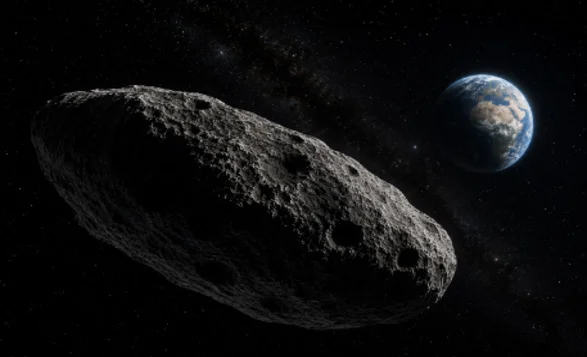
Asteroid Apophis will make one of the closest flybys in history, becoming visible to billions of people across Earth
One of the most anticipated asteroid flybys of the century will take place on April 13, 2029, when asteroid 99942 Apophis passes remarkably close to Earth. Astronomers say the event will be unlike anything most people have ever witnessed.
For the first time in modern history, a large asteroid will become bright enough to see with the naked eye. Billions of people will be able to watch it move across the night sky without using a telescope.
According to current orbital calculations, Apophis (NASA) will pass within approximately 30,600 kilometers (19,000 miles) of Earth. That is closer than the orbit of many communication satellites. It makes this one of the closest known approaches ever predicted for an asteroid of this size.
The asteroid was discovered in 2004 and immediately attracted worldwide attention. Early calculations suggested there was a small chance it could collide with Earth in the future. The possibility generated headlines across the globe.
Years of additional observations later allowed astronomers to calculate its orbit with much greater precision. Scientists have now confirmed that Apophis poses no impact threat to Earth for at least the next 100 years.
Even so, Apophis remains officially classified as a potentially hazardous asteroid. The designation is based on its size and the distance of its orbit from Earth. The asteroid measures about 450 meters (1,480 feet) across.
That is roughly the height of a modern skyscraper. Scientists continue monitoring objects like Apophis because they could become important targets for future planetary defense studies.
VIDEO. Apophis (potentially dangerous asteroid) flyby in 2029.
Why the 2029 Apophis flyby is a once-in-a-lifetime event
Scientists believe Apophis originally formed in the main asteroid belt between Mars and Jupiter. Over millions of years, gravitational interactions gradually pushed it toward the inner Solar System.
Today the asteroid completes one orbit around the Sun every 10.5 months. Its path regularly crosses the orbital region of Earth, making it one of the best-known near-Earth asteroids.
The 2029 encounter will provide a unique scientific opportunity. Observatories around the world will point their telescopes toward Apophis.
Planetary radar systems will also examine the asteroid in exceptional detail. Researchers hope to learn more about its shape, surface, rotation, density, and internal structure.
Earth’s gravity is expected to slightly influence the asteroid during the close flyby. Even a small change in its rotation or trajectory would help scientists better understand how large asteroids respond to gravitational forces.
The information will improve computer models used to predict the motion of future near-Earth asteroids.
Nearly 90% of the world’s population, or around 7.6 billion people, will have an opportunity to see Apophis during different stages of the flyby. That makes it one of the most widely visible astronomical events ever predicted in advance.
Observers across Australia and much of Asia will see the asteroid first. Later, Apophis will become visible over eastern South America, northern Africa, and parts of Europe.
During its closest approach, the best views are expected across Asia, the Middle East, East Africa, southern Europe, and Australia. Clear skies will provide ideal viewing conditions.
North America will be the only major populated region where the closest stage of the flyby will not be easily visible. However, leading observatories will broadcast the event live online.
Millions of additional viewers are expected to follow the historic encounter through livestreams.
NASA, the European Space Agency (ESA), and astronomers worldwide are already preparing extensive observation campaigns. The data collected during the flyby will improve planetary defense research and expand our understanding of potentially hazardous asteroids.
Although Apophis once raised concerns about a possible impact, the 2029 encounter is now expected to become a spectacular scientific event instead of a global threat. For billions of people, it will be a rare chance to witness a massive near-Earth asteroid safely passing through our cosmic neighborhood.
Sources: NASA Center for Near Earth Object Studies (CNEOS), European Space Agency (ESA).
Previously, scientists were warning about another threat. According to the latest information, an asteroid could collide with Earth in 2032. It is believed that the asteroid, named 2024 YR4, could have the power of a nuclear bomb.