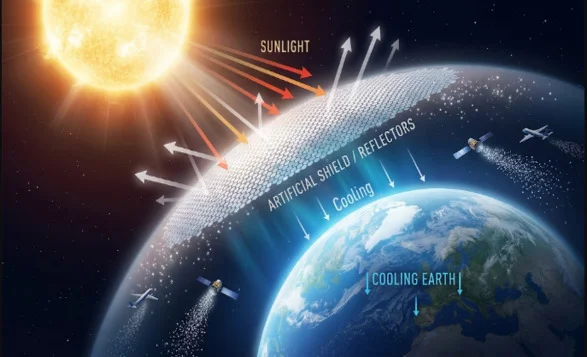
US and Europe Explore Solar Geoengineering to Cool Earth
Policymakers in the US and Europe are taking a closer look at an idea that was once considered too controversial to discuss seriously: deliberately reducing the amount of sunlight reaching Earth to slow global warming.
According to Politico, officials and researchers are examining solar geoengineering, also known as solar radiation modification. The basic concept is to reflect a small amount of sunlight back into space, potentially lowering global temperatures.
One approach involves releasing reflective particles into the stratosphere.
The idea is inspired by major volcanic eruptions, which can temporarily cool the planet by sending particles high into the atmosphere. But deliberately doing this would carry significant risks, and many of its effects remain uncertain.
Researchers have warned that changing the amount of sunlight reaching Earth could also alter weather patterns.
Some regions could receive less rainfall, creating additional pressure on agriculture and water supplies. The effects would not necessarily be distributed evenly around the world.
VIDEO. Solar Geoengineering: A Bold Solution or a Global Disaster?
There is another fundamental problem. Solar geoengineering would not remove the greenhouse gases already accumulating in the atmosphere. It could potentially reduce some effects of warming, but it would not address the emissions that are driving climate change.
So why has the subject returned to policy discussions?
Rising global temperatures have increased interest in technologies that could potentially be used during a severe climate emergency. At the same time, private funding and research into solar geoengineering have expanded.
That does not mean governments are preparing to deploy such technology. Large-scale atmospheric experiments remain highly controversial, and there is no international agreement allowing a global solar geoengineering program.
The important change is that the subject is no longer being discussed only as a distant theoretical possibility. It is increasingly appearing in serious discussions about how governments might respond if conventional efforts to limit global warming prove insufficient.
It was previously reported that after a recent horrific 7.4-magnitude earthquake, an ominous blood-red sky appeared over Colombia, and local residents attribute this strange phenomenon to seismic activity.