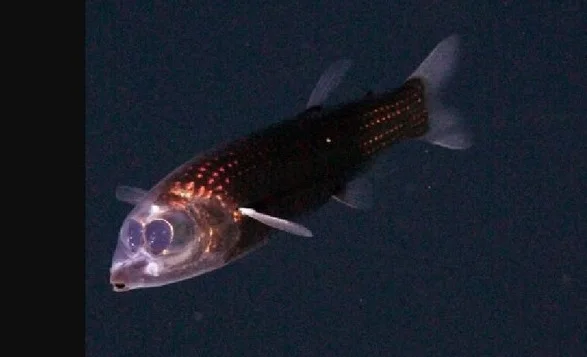
Rare deep-sea fish with transparent head filmed alive for the first time in the Atlantic Ocean
Scientists have recorded one of the ocean’s most mysterious creatures alive in its natural habitat for the first time. During a recent deep-sea expedition in the central Atlantic Ocean, researchers captured remarkable footage of Winteria telescopa, a rare deep-sea fish known for its transparent head and unusual tubular eyes.
The discovery was made during a 35-day expedition aboard the research vessel Falkor (too), operated by the Schmidt Ocean Institute. The mission focused on exploring poorly studied areas of the Atlantic Ocean. It also revealed several important geological discoveries beneath the seafloor.
Marine biologists consider the observation a major breakthrough. The fragile anatomy of this species has made it almost impossible to study living individuals until now. Previously, scientists only examined damaged specimens recovered in fishing nets.
The new footage provides the clearest view yet of how the fish behaves in its natural deep-sea environment.
Researchers filmed the rare fish at a depth of about 710 meters (2,330 feet). Almost no sunlight reaches this part of the ocean. Many animals living there depend on bioluminescence to find food or avoid predators.
One of the most remarkable features of Winteria telescopa is its transparent, fluid-filled head. Inside the transparent dome are two large tubular eyes positioned parallel to each other. This unusual structure allows the fish to detect even the faintest flashes of light in the darkness.
Video Instagram Schmidt Ocean.
Scientists believe this highly specialized vision helps the predator locate prey while avoiding larger animals. Similar eye structures are found in only a few deep-sea fish species, making Winteria telescopa one of the ocean’s rarest vertebrates.
Recovering intact specimens has always been extremely difficult. The enormous pressure of the deep ocean protects the delicate skull. When the fish is brought to the surface, the rapid pressure change often destroys the transparent head before scientists can study it.
The expedition explored the Doldrums Fracture Zone. This region lies in the central Atlantic Ocean about 1,300 kilometers (800 miles) northeast of Brazil. It crosses the Mid-Atlantic Ridge, the longest mountain range on Earth.
While mapping the seafloor, researchers discovered two previously unknown hydrothermal fields. These underwater hot springs release mineral-rich fluids from deep inside Earth’s crust. They also support unusual ecosystems that survive without sunlight.
Hydrothermal vents are among the most important environments in marine science. Organisms living there rely on chemical energy instead of photosynthesis. Researchers believe many unknown species may still inhabit these isolated ecosystems.
According to expedition leader Aaron Micallef, even regions studied for decades continue to surprise scientists. The latest discoveries show how little is still known about Earth’s deepest oceans.
Researchers are now examining video recordings, biological samples, and environmental data collected during the expedition. The results will improve our understanding of deep-sea biodiversity, hydrothermal systems, and the remarkable adaptations that allow Winteria telescopa to survive in one of Earth’s most extreme environments.
Sources: Schmidt Ocean Institute – The Doldrums Fracture Zone is Anything but Dull.
It was previously reported that global warming is leading to the largest loss of coral reefs in history. Scientists say more than 80% of the world’s reefs are suffering from bleaching.