Global warming causes the largest coral reef loss in history
Coral reefs around the world are facing their biggest bleaching crisis ever recorded. Scientists say the latest global event has already affected more than 80% of reef systems, making it the most widespread episode since scientists began tracking coral bleaching.
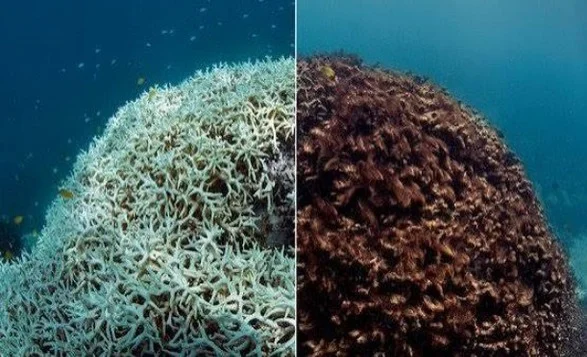
Bleaching begins when ocean temperatures stay too high for too long. Corals respond to this stress by expelling the tiny algae, known as zooxanthellae, that live inside their tissues.
These microscopic organisms provide most of the coral’s energy through photosynthesis while also giving reefs their bright colors. Once they disappear, the corals turn white. If cooler conditions do not return quickly, many colonies eventually die.
According to the International Coral Reef Initiative, this is now the fourth global coral bleaching event ever documented. Unlike earlier episodes, however, today’s crisis is affecting a much larger area at the same time.
VIDEO. Coral bleaching is affecting nearly all the world’s reefs, new NOAA report says.
Why Coral reefs are disappearing faster than Scientists expected
Researchers say the biggest concern is that the oceans have remained unusually warm for several consecutive years.
Even though the recent El Niño event has weakened, sea surface temperatures have stayed close to record highs across many tropical regions. That leaves damaged reefs with very little time to recover before another period of extreme heat arrives.
Some coral species are proving more resilient than others. In certain locations they have adapted to warmer waters or developed relationships with more heat-tolerant strains of zooxanthellae.
Scientists consider these cases encouraging, but they also warn that natural adaptation is happening far more slowly than the pace of global warming.
As bleaching becomes more frequent, many reefs begin to lose their complex three-dimensional structure. Fish and countless other marine animals depend on these habitats for food, breeding and shelter.
Once living corals disappear, algae often take over, transforming vibrant reef ecosystems into much less diverse underwater landscapes.
Although coral reefs cover less than one percent of the ocean floor, they support nearly a quarter of all known marine species. Their importance extends well beyond marine life.
Healthy reefs help weaken storm waves before they reach the coast, reduce erosion, support commercial fisheries and attract millions of tourists every year. For hundreds of millions of people, coral reefs are directly connected to food security and local economies.
Marine experts say protecting reefs will require more than local conservation efforts.
Restoration projects, marine protected areas and improved water quality can strengthen reef resilience, but reducing greenhouse gas emissions remains the most effective long-term solution for slowing global coral bleaching and preserving these ecosystems for future generations.
It was previously reported that scientists successfully tested a new plan to refreeze the Arctic. This could be achieved by creating thicker sea ice as part of a groundbreaking climate experiment.