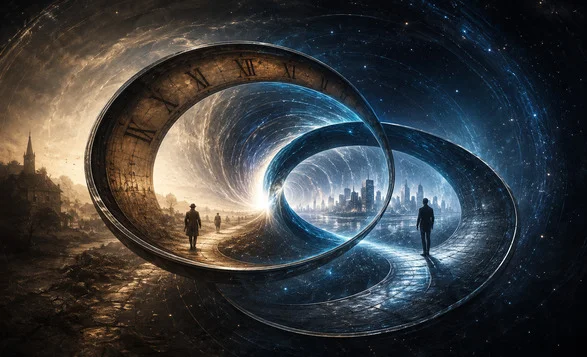
Quantum Study Suggests Information Can Travel Back in Time
Time travel has always been one of the most popular ideas in science fiction. Movies, books, and television shows have imagined people sending messages through time for decades. Now a new study suggests that, at least on paper, sending information into the past may not be completely impossible.
A team of theoretical physicists led by Cornell University researcher Mark Wilde has been looking at a question that sounds simple but is surprisingly difficult: can information move backward through time without breaking the known laws of physics?
The researchers were not building a time machine. Instead, they examined mathematical models that already exist in modern physics. Their work focused on so-called closed timelike curves, a concept that appears in certain solutions to Einstein’s theory of relativity.
These hypothetical pathways would allow an object or a piece of information to leave one point in spacetime and eventually arrive at an earlier moment. In other words, something could return to its own past.
For many physicists, that immediately raises a problem. If information can be sent into the past, what happens if that information changes the future that originally created it? This is the source of famous time-travel paradoxes that have puzzled scientists for generations.
Video on the topic. The Strange Case of Quantum Time Loops And Testing Backward Time Travel.
Could Quantum Physics Make Travel Back in Time Possible?
One well-known example is the so-called “grandfather paradox.” A traveler goes back in time and changes an event that prevents their own journey from ever taking place. Situations like this are one reason many researchers doubt that real time loops can exist in nature.
The authors of the new study argue that quantum mechanics may offer a different perspective. At the quantum level, particles do not always behave according to common sense. Events that seem impossible in everyday life can sometimes be described mathematically without creating direct contradictions.
Using information theory and quantum communication models, the team found that a message could theoretically be transmitted through a quantum time loop. The process would not be perfect. Some information could be distorted or lost along the way, much like interference affecting a weak radio signal.
Even with those limitations, the calculations suggest that enough information might survive to make communication possible. The researchers compared parts of the process to quantum teleportation, a phenomenon that has already been demonstrated in laboratory experiments.
Despite its name, quantum teleportation does not transport people or objects from one place to another. Instead, it transfers quantum information between particles. Scientists have spent years improving these techniques, and they now form an important part of quantum computing and quantum communication research.
The study also touches on another major mystery in physics: what happens to information inside black holes. Some theories suggest that black hole evaporation could involve processes similar to quantum teleportation. If true, that could help explain how information survives even when matter falls into a black hole.
However, the new research points to several information-related limits that such theories would need to overcome. According to the authors, some popular explanations may be more difficult to reconcile with the mathematics than previously thought.
That does not mean existing black hole theories are wrong. It simply means that physicists may need to take a closer look at how information behaves under extreme conditions.
For now, the idea of sending a message into the past remains firmly in the realm of theory. There is no evidence that closed timelike curves exist, and no technology is capable of creating them. Even so, the study highlights how many unanswered questions remain about time, gravity, and the quantum world.
Whether these quantum time loops turn out to be real or not, the research provides another reminder that the universe often behaves in ways that challenge our intuition. Concepts that once belonged entirely to science fiction continue to find their way into serious scientific discussions.
The study was conducted by a team of theoretical physicists led by Mark Wilde of Cornell University and published in the journal Physical Review Letters.
It was previously reported that scientists were able to calculate the exact date of the end of the world on Earth. According to Japanese scientists, the main cause of the end of the world on our planet could be a lack of air. The published data is based on mathematical calculations.