People Are Speaking Less Every Year
I always thought humans were the most talkative creatures on the planet. But lately I’ve noticed something disturbing — we’re speaking much less than before. And it turns out this isn’t just my feeling. It’s a scientifically proven reality.
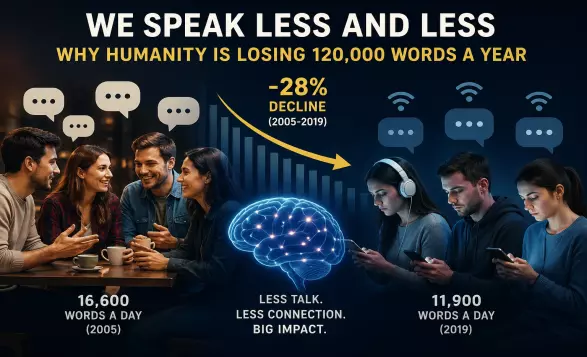
Some estimates suggest that people may speak up to 120,000 fewer words per year than before. That’s roughly the size of a small book we simply never say out loud.
Similar findings were also reported in a recent article by The Wall Street Journal, which highlighted research showing a noticeable drop in the number of words people speak each day over the past two decades.
From 16,600 Words a Day to Almost Silence
Professor Matthias Mehl from the University of Arizona has spent years studying real everyday conversations using wearable recorders. His team analyzed thousands of people across different continents. The results are shocking: between 2005 and 2019, humanity spoke 28% less overall.
The daily average dropped from 16,600 words to about 11,900. Researchers believe that digital tools, messaging apps, and remote lifestyles may have contributed to the decline. This trend continues to attract attention from scientists studying human communication.
“We didn’t suddenly go silent. We simply gradually removed every single excuse we had to open our mouths.”
Delivery apps have replaced small talk with cashiers. Headphones and AirPods have cut off conversations with people around us in public transport. Messaging apps have taken over even intimate moments with family and partners at the dinner table. We haven’t stopped communicating — we’ve just moved everything to text, where voice, tone, and real human connection slowly disappear.
The most worrying part is what this means for children. When a mother looks at her phone near her baby, she speaks to the child 16% less. Even a quick one- or two-minute glance at the screen reduces the number of words directed at the baby by up to 26%.
A child’s brain development in the early years is directly connected to how many live words they hear from adults. Fewer spoken words mean weaker stimulation for language skills, emotional intelligence, and social abilities.
The next generation is growing up in a much quieter world than we did. Scientists still don’t know exactly what long-term global impact this will have on humanity, but the warning signs are already clear and concerning.
Researchers describe this as a clear long-term trend that deserves continued observation and study.
Based on research by Professor Matthias Mehl from the University of Arizona and studies on how smartphones affect parental speech and child development.