Scientists say more than 1,100 marine species have been identified in the world’s oceans over the last year.
The number comes from the Ocean Census project, an international effort focused on discovering and recording ocean life. Researchers involved in the project say 1,121 species were documented during recent expeditions in different parts of the world.
Some of the discoveries look unlike anything most people would expect to see underwater.
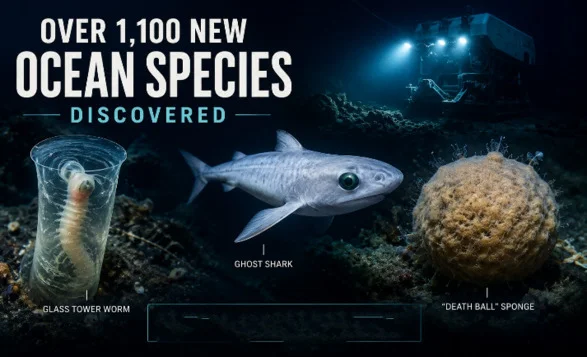
Among them is a worm that lives inside a fragile transparent tube. Researchers described it as looking like a tiny glass structure rising from the seafloor. Another discovery was a ghost shark, a rare deep-water fish that has been seen only a few times before. Scientists also reported finding a predatory sponge that has been nicknamed the “death ball.”
All three were found in the deep ocean, where sunlight does not reach and conditions remain difficult even for research equipment.
The Ocean Census includes more than 1,000 scientists from 85 countries. Its goal is to speed up the identification of new ocean species before marine habitats change or disappear.
Researchers say much of the ocean is still poorly studied. While satellites have mapped the surface of the planet in detail, large parts of the seafloor remain largely unexplored.
That is one reason why expeditions continue to find new forms of marine life, especially at great depths.
Scientists are also paying closer attention because ocean ecosystems are changing. Water temperatures are rising in many regions, while pollution and industrial activity continue to affect underwater habitats.
Deep-sea mining has become another concern. Some experts warn that parts of the ocean floor could be disturbed before researchers fully understand which species live there.
The Ocean Census team says this is only the beginning. Thousands of animals living in the deep sea may still be unknown to science, and new discoveries are expected as more missions continue.
This article is based on reporting by CNN Newsource, originally published on KTVZ.
We previously wrote about scientists’ warning about sharks. They found that significantly increased ocean acidity can negatively impact shark teeth. Such problems in predators can reduce their hunting abilities.