Scientists Claim They Have Solved the Mystery of the Ghost Ship Mary Celeste
The story of the Mary Celeste is one of those maritime mysteries that never really disappears from public attention. The Daily Star reports this discovery.
Every few years it comes back into discussion, usually when people talk about ghost ships or unexplained events at sea. Now, researchers say there might finally be a reasonable explanation for what actually happened.
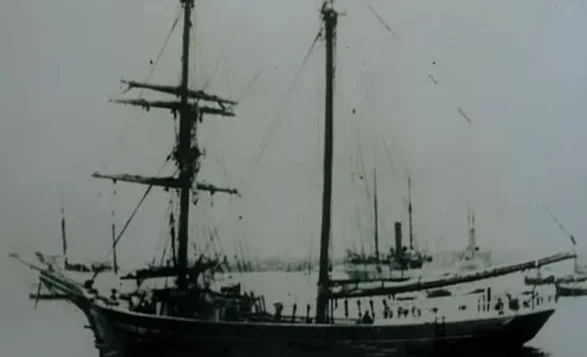
The ship was found on December 4, 1872, drifting in the Atlantic Ocean, roughly 650 kilometers from Gibraltar. What made the discovery so strange wasn’t just that the vessel was empty, but that everything else looked completely normal.
The ship itself was not damaged, there were no clear signs of a struggle, and nothing obvious that could explain why the crew suddenly disappeared.
Even more confusing was the fact that personal belongings were still on board and the cargo had not been touched. Over time, this combination of details turned the Mary Celeste into one of the most famous examples of a “ghost ship” in maritime history, surrounded by speculation and theories.
Alcohol Vapor Explosion Theory and Scientific Experiment
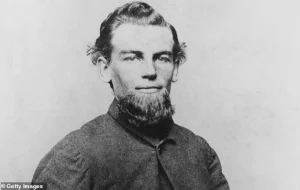
According to a theory put forward in the 1940s by physician Oliver Cobb, the crew abandoned the ship due to an explosion of alcohol vapor in the hold. The Mary Celeste was carrying 1,700 barrels of pure alcohol from New York to Genoa.
Investigators discovered nine barrels were empty. Cobb suspected the barrels were leaking. Due to bad weather, the crew had to secure the hatches in the hold.
When the Mary Celeste reached warmer waters and the hatches were reopened, the alcohol vapors accumulated in the confined space mixed with oxygen and exploded upon contact with a flame, such as a coal from one of the sailors’ pipe.
Fearing another explosion, the crew temporarily abandoned the Mary Celeste in lifeboats to wait for the holds to air out. However, due to a storm, the ship accelerated to high speed, and the sailors were unable to catch it. The lifeboats were then capsized by the waves.
Jack Rowbotham and Frank Mair conducted an experiment on a 1:18 scale model of the brigantine. They filled the hold with a mixture of ethanol vapor and air.
When the temperature was low, as in New York City when the Mary Celeste sailed, the mixture did not explode from an electrical discharge.
However, when the scientists simulated warm weather, which was common at the site where the ship was discovered, the same discharge caused a powerful explosion that blew out the hatches on the model.
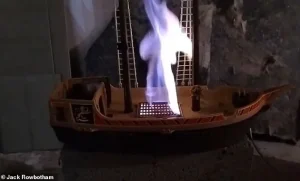
Due to the rapid combustion of the alcohol vapor, the hold of the model was undamaged, even though the temperature at the time of the explosion reached two thousand degrees Celsius.
Now British chemists consider Cobb’s theory proven. They stated that their experiment disproves the “numerous wild conspiracy theories” surrounding the fate of the Mary Celeste’s crew.
Even so, the final fate of the crew is still not confirmed with absolute certainty. The Mary Celeste remains one of those rare historical cases where science can explain parts of the story, but not the entire picture.
Video: Ghost Ship Mary Celeste: The 150-Year Mystery. YouTube channel: Part-Time Explorer.
We previously reported on another historic discovery. After more than 400 years of mystery and enigma, scientists have finally determined the exact location of William Shakespeare’s London home.