Dragonflies See Red Light Like Humans: A Sensational Discovery
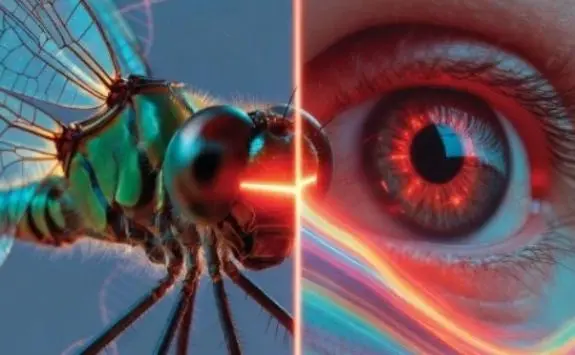
Scientists from Osaka University have discovered that dragonflies perceive red light almost identically to mammals, including humans. This is a striking example of parallel evolution, where completely different species independently arrive at the same biological solution.
The results of the study will be published in the journal Cellular and Molecular Life Sciences in 2026.
Human vision depends on opsins—proteins that detect blue, green, and red light. Scientists have discovered a special opsin in dragonflies, RhLWA2, that is sensitive to a wavelength of approximately 720 nanometers. This is the near-infrared range, which the human eye cannot detect.
This ability helps dragonflies quickly distinguish between males and females in flight: their bodies reflect red and near-infrared light differently. Without this precise “infrared vision,” successful mating would be nearly impossible for these fast predators.
Mechanism of dragonfly opsin
The most astonishing thing is that the mechanism of dragonfly opsin is completely identical to that of mammalian red opsin. Insects and mammals diverged in evolution over 600 million years ago, yet nature has invented the same molecular solution twice. A mutation at amino acid position 292 of the protein plays a key role.
The researchers didn’t stop at describing it. They changed one amino acid in the dragonfly opsin and created a new variant that responds even better to near-infrared light. This protein has already successfully activated cells exposed to infrared radiation in the laboratory.
This discovery provides a powerful boost to optogenetics—the technology of controlling cells using light. Infrared radiation penetrates deeper into tissue than visible light. Therefore, these new opsins will allow scientists and doctors to target previously inaccessible areas of the brain and organs.
Dragonflies, with their compound eyes and complex behavior, are an ideal subject for such research. They have existed on Earth for over 300 million years and possess a record number of opsin genes among insects.
A new discovery explains how evolution has given dragonflies the ability to see red light deeper than other species. Thus, these tiny insects are helping humanity take a step toward high-tech medicine.
Dragonfly vision not only advances our understanding of evolution but also opens up real prospects for the treatment of neurodegenerative diseases and the development of new methods for contactless cell stimulation.
We previously reported on a different issue. Global scientists have warned of the potential extinction of birds. According to recent studies, 517 bird species on the planet could become extinct within the next 100 years.