Mars North Pole Ice Surprise: Chance for Extraterrestrial Life
The northern polar cap of Mars has been hiding a secret that could completely transform our search for extraterrestrial life. For decades, planetary scientists assumed the Red Planet’s massive icy crown was a filthy mixture of frozen water and fine global dust.
However, fresh observational data from orbiting spacecraft has shattered those long-held geological models. The ice is actually remarkably pure. The study was published in the journal npj Space Exploration, Sci News reports.
Previous computer simulations estimated that Martian polar glaciers contained as much as 25% atmospheric dust mixed into their structure. Yet a new analysis examining six distinct northern polar regions paints a drastically different picture.
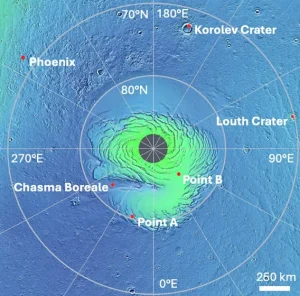
Across the studied areas, airborne dust accounts for less than 3% of the total ice mass. Scientists were stunned to find vast stretches of crystal-clear frozen water instead of dirty sludge.
This striking difference in purity isn’t just a physical curiosity. It fundamentally alters how the ice interacts with solar radiation and climate cycles.
Darker, dirt-heavy ice rapidly absorbs heat from sunlight and erodes at an accelerated rate. In sharp contrast, pristine ice acts like a giant natural mirror.
It reflects the sun’s rays, keeping the massive polar sheets stable over millions of years of atmospheric changes.
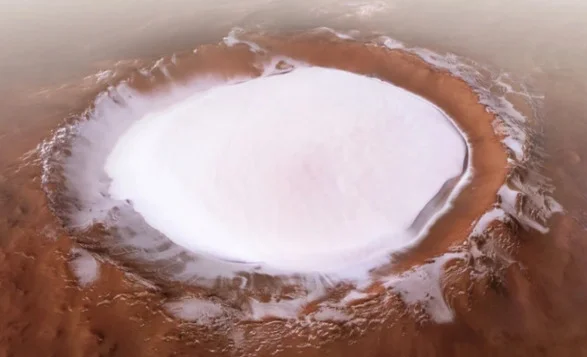
High-resolution data came from key sites including Korolev Crater, Chasma Boreale, Louth Crater, and the Phoenix landing zone. The northern polar cap is built in distinct, rhythmic layers.
VIDEO. Icy Mars Korolev crater is 51 miles across – Flyover animation from orbiter imagery.
Beneath a thin blanket of seasonal winter frost lie ancient glacial strata separated by narrow bands of dark sediment. It functions like a frozen climate archive, similar to polar ice cores drilled on Earth.
The most thrilling discovery lies where clean ice meets dusty sediment layers. Sunlight penetrating these translucent boundaries could occasionally warm the dark dust particles just enough to melt surrounding ice.
This subtle process creates temporary, microscopic pockets of liquid water beneath the surface. On Earth, hardy microorganisms thrive inside nearly identical sub-surface icy conditions.
They simply enter a dormant state whenever the water refreezes. While no living organisms have been detected on Mars yet, these newly identified liquid pockets offer prime targets for future bio-signature searches.
It was also previously reported that after a recent study of mysterious spots on the surface of Mars, NASA scientists stated that the only explanation for this mystery and their presence is possible biological activity on the planet.