Curiosity discovers mysterious holes on Mars
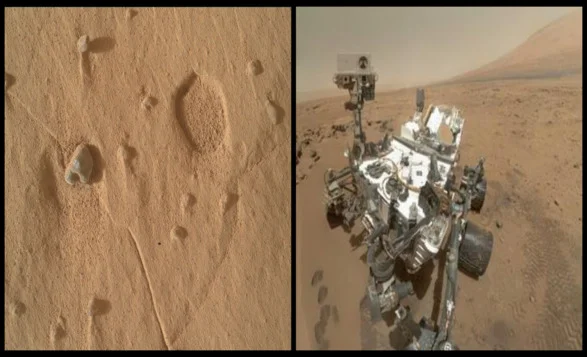
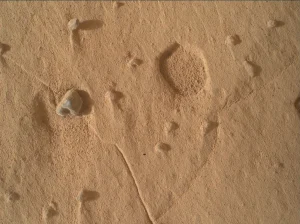
NASA’s Curiosity rover has photographed unusual holes in the Martian surface that do not have an obvious explanation.
The strange formations appeared in Valle Grande, a broad valley on the slopes of Mount Sharp inside Gale Crater. Curiosity is currently climbing through this region while examining ancient rocks that preserve evidence of how the Martian environment changed over time.
Small pits and cavities are common across Mars. Billions of years of wind erosion, impacts and chemical weathering have continually reshaped the planet’s rocky surface. Photo and information: NASA Science
What makes these particular features interesting is their unusual appearance. The holes look relatively broad and shallow, while the surrounding material does not immediately reveal an obvious rock or mineral layer that could have fallen away.
One possible explanation involves differences in the hardness or composition of the Martian rock. If a softer material surrounded a more resistant inclusion, erosion could eventually expose or remove it, leaving a cavity behind.
Scientists are examining whether that familiar process can explain the new structures. The rover’s cameras can provide close views of the texture, edges and interior of the holes, while observations from different angles can help reconstruct their three-dimensional shape.
Curiosity is exploring a changing landscape on ancient Mars
The discovery comes as Curiosity investigates a geologically important part of Mount Sharp. The mountain rises about 5 kilometers (3 miles) above the floor of Gale Crater and contains layers formed during different periods of Martian history.
These layers are especially valuable because the rover has already found evidence that Gale Crater once contained lakes and flowing water. The chemistry of the rocks also suggests that Mars experienced major environmental changes as its ancient climate became increasingly dry.
Curiosity recently explored another remarkable feature in Valle Grande: a huge field of polygonal fractures resembling a giant honeycomb. Individual polygons measure about 4 to 8 centimeters (1.5 to 3 inches) across, and scientists said they had never seen so many together in one location.
The rover is now continuing upward through sulfate-rich rocks. These deposits are important because sulfates can preserve clues about periods when water became scarce or conditions on Mars changed significantly.
VIDEO NASA. Two Rovers, Billions of Years of Martian History – NASA’s Perseverance and Curiosity Rovers.
Close-up observations from instruments such as the Mars Hand Lens Imager and Mastcam can help scientists compare the mysterious holes with nearby rocks. Chemical measurements may also reveal whether differences in mineral composition played a role in their formation.
For now, there is no evidence that the holes were created by anything artificial or biological. They are best described as unusual geological features whose origin requires further investigation.
As Curiosity climbs higher on Mount Sharp, each new layer provides another piece of the planet’s complicated geological history. The mysterious holes may eventually prove to have a simple explanation, but for now they remain another intriguing puzzle on the surface of Mars.
It was previously reported that Mars explorers spotted a strange figure in an archival NASA image taken on Mars. The figure resembled a jellyfish: the mysterious object appeared to be hovering near the Curiosity rover.