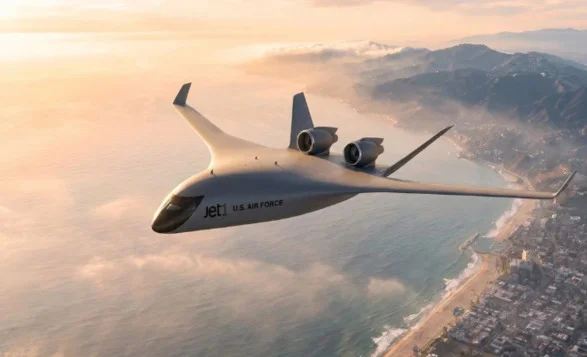
JetZero Z4: the Future of Passenger Aviation
It has been announced that American aerospace company JetZero has begun development of the Z4, an innovative passenger jet designed to challenge the traditional shape of commercial aircraft. This new passenger jet, shaped like a giant manta ray, could become one of the most unusual inventions in modern aviation. This was reported on the official JetZero website.
The project has gained renewed attention after the US Federal Aviation Administration awarded JetZero $5.3 million. The funds will be used for flight testing of engines mounted above the aircraft’s main fuselage. Engineers hope that measurements will help demonstrate how this unusual configuration performs in real-world operating conditions. Unlike conventional passenger jets, the Z4 does not have the traditional design of a long, cylindrical fuselage with wings attached to its sides.
Instead, its fuselage and wings merge into a single, continuous aerodynamic structure. Aeronautical engineers call this configuration a “blended wing body” (BWB).
The new concept offers several potential advantages over traditional aircraft. By converting a significant portion of the aircraft’s fuselage into a lifting surface, engineers can reduce aerodynamic drag and improve overall efficiency. This will allow future passenger aircraft to carry more people while consuming significantly less fuel.
JetZero claims its Z4 aircraft can achieve up to 50% greater fuel efficiency than comparable conventional aircraft using the same powerplant technology. These savings will be significant for airlines, where fuel remains one of their largest expenses.
The new concept and advantages of JetZero Z4
Another unusual feature is the aircraft’s engine placement. Instead of hanging under the wings, they are mounted on top of the rear of the aircraft. This arrangement is intended to reduce engine noise reaching populated areas around airports. A new study, funded by the Federal Aviation Administration (FAA), will measure airflow into and out of engines during takeoff, climb, cruise, and ground operations in crosswinds.
The idea of creating aircraft without a traditional fuselage is not entirely new. American aviation pioneer Jack Northrop experimented with flying wing designs in the 1940s. His work ultimately led to the creation of several remarkable experimental aircraft, although commercial aviation continued to favor traditional configurations.
Modern materials, powerful computers, and advanced flight control systems have made more complex aerodynamic shapes increasingly practical. JetZero believes these developments can finally bring the blended wing concept to the commercial passenger market.
The company is currently building a full-scale demonstrator, called Jet1, which will test the technology before entering commercial production. The aircraft is being built by Scaled Composites, a Northrop Grumman company. Its first flight is scheduled for the fourth quarter of 2027.
The production Z4 is designed for the market currently served by medium- and long-range passenger jets. JetZero plans to enter service in the early 2030s, although this is contingent on successful testing and regulatory certification.
If the project is successful, passengers could eventually board aircraft that will look completely different from today’s familiar airliners. The manta-ray design could represent a major change in aviation, combining a distinctive appearance with the promise of reduced fuel consumption and quieter flights.
Earlier, reports emerged that Chinese specialists had unveiled their new concept for a giant “flying wing” passenger aircraft. The new aircraft would be capable of carrying over 800 passengers and would rival the world’s largest modern passenger airliners.