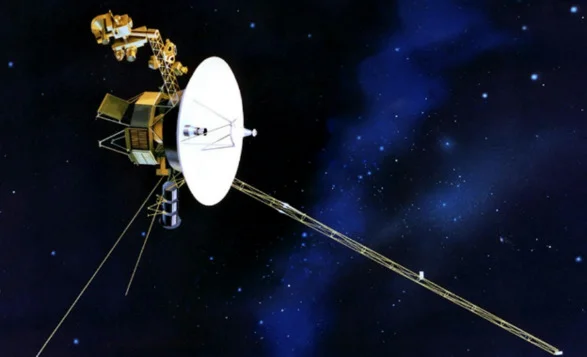
Voyager 1: One Light-Day From Earth After 49 Years
NASA’s Voyager 1 is approaching a milestone that no other human-made spacecraft has ever reached. On November 18, 2026, the probe is expected to be approximately 25.9 billion kilometers from Earth, a distance light travels in an entire day.
This means that a radio signal sent from Earth will need 24 hours to reach the spacecraft. Any response will take another 24 hours to return. A simple exchange of commands and data will therefore involve a delay of almost two days.
But the most remarkable part of this achievement is not the distance itself. Voyager 1 is still operating with technology developed more than half a century ago.
Voyager 1 was launched on September 5, 1977, aboard a Titan IIIE-Centaur rocket. Its twin, Voyager 2, had actually left Earth 16 days earlier, on August 20. Both spacecraft were originally designed for a mission lasting around five years, with the primary goal of exploring Jupiter and Saturn.
The timing of the launches was no coincidence. Scientists had identified a rare alignment of the outer planets that made it possible to use their gravity to redirect a spacecraft from one giant planet toward another. This technique, known as a gravity assist, allowed the Voyagers to travel much farther without carrying enormous amounts of additional fuel.
VIDEO. NASA’s Voyager 1 launches aboard a Titan IIIE-Centaur rocket on September 5, 1977. Archival footage: NASA/JPL, via Wikimedia Commons.
The probes transformed our understanding of the outer Solar System. Voyager 1 discovered previously unknown moons and a faint ring around Jupiter before reaching Saturn in 1980. Its twin continued farther, eventually becoming the first spacecraft to fly past Uranus and Neptune.
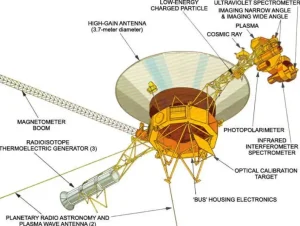
The technology aboard Voyager 1 is particularly remarkable by modern standards. Its three onboard computer systems have a combined memory capacity of approximately 68 kilobytes. Yet these computers control the spacecraft, process scientific information and respond to problems without direct human intervention.
Voyager also carries a golden record, a gold-plated copper disc containing sounds, music, greetings in 55 languages and images representing life and civilization on Earth. It was designed as a message to any extraterrestrial intelligence that might one day encounter the spacecraft.
The Golden Record aboard Voyager carries a message from humanity to the cosmos, featuring sounds, music, images and greetings in 55 languages. Video: United Nations.
A spacecraft designed in the 1970s that refused to stop working
Keeping Voyager alive has become an engineering challenge of its own. The probe receives electricity from three radioisotope thermoelectric generators, which convert heat produced by the radioactive decay of plutonium-238 into electrical power. Their output gradually decreases, costing the spacecraft approximately four watts of power every year.
NASA engineers have therefore been forced to switch off instruments and other equipment to preserve energy. In September 2026, they completed an unusual operation called Big Bang, replacing three power-consuming devices with lower-energy alternatives. The spacecraft currently has two scientific instruments still operating, studying magnetic fields and plasma waves in interstellar space.
The probe even survived a worrying communications interruption in October. NASA temporarily lost its signal for almost two days before contact was restored. Engineers discovered that one group of orientation thrusters had switched off and backup units had activated automatically.
Voyager 1 crossed the heliopause in August 2012, entering interstellar space beyond the Sun’s protective bubble of solar particles and magnetic fields. It is still travelling at approximately 61,000 kilometers per hour.
Voyager 1 reaches interstellar space. Video: NASA/JPL, September 12, 2013.
When it reaches one light-day from Earth, nothing dramatic will happen to the spacecraft itself. But the milestone will demonstrate just how far human engineering can reach. A machine built in an era before personal computers became commonplace is still sending information across a distance of nearly 26 billion kilometers, long after the mission it was designed for should have ended.
It has also become known that NASA’s Swift space telescope is losing altitude and is at risk of falling to Earth. The NASA telescope has been increasingly close to an uncontrolled re-entry into the atmosphere after 22 years in Earth orbit.