Scientists Find a Way to Solve the Moon’s Growing Waste Problem
Humanity has left behind a huge amount of trash and old equipment on the Moon over the past 65 years. But what appears to be an abandoned collection of spacecraft, tools, and broken equipment could ultimately become a valuable resource for future lunar explorers.
Experts estimate that approximately 187,000 kilograms of human-made materials currently reside on the lunar surface. This is roughly equivalent to the weight of a Boeing 747 passenger jet. Popular Science reports this, citing statements by European Space Agency (ESA) specialist Aidan Cowley.
Since the Soviet Luna 2 probe reached the Moon in 1959, more than 140 missions have been sent to Earth’s natural satellite. Twelve astronauts have walked on its surface, and seven rovers have also been left behind.
A significant portion of this material consists of landing equipment. During NASA’s Apollo missions, the lunar modules were designed to leave their lower sections behind on the Moon. Only the upper portion of the vehicle returned to lunar orbit, transporting the astronauts back to the main spacecraft.
Among the abandoned equipment are also robotic rovers, scientific instruments, toolboxes, and special probes intentionally dropped on the surface for research.
However, these objects aren’t simply lying untouched. The Moon lacks a thick atmosphere to protect them from the harsh environment. Micrometeorite impacts, intense solar radiation, and sudden temperature changes gradually damage exposed materials.
Scientists believe that studying these damaged objects can reveal how different materials behave in the lunar environment. Such research could help engineers develop better protection for solar panels and other equipment used by future settlements.
Could old spacecraft become building materials?
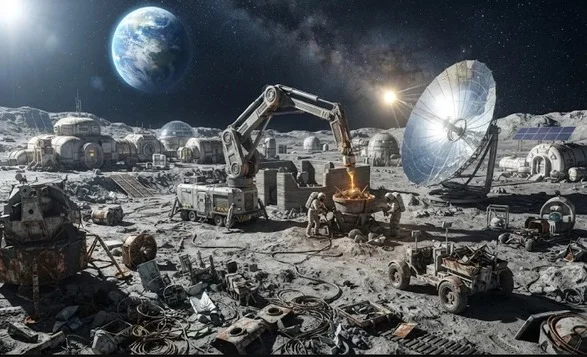
The European Space Agency is exploring ways to recycle some of the equipment already abandoned on the Moon. One promising approach involves using 3D printing to convert metal scrap into new materials and structures.
Many lunar spacecraft were built using lightweight aluminum. According to ESA specialist Aidan Cowley, concentrated sunlight could potentially melt this metal directly on the lunar surface.
The recycled material could then be used to manufacture components, eliminating the need to transport all the necessary resources from Earth. This could be especially important for the creation of permanent lunar bases.
However, significant technical hurdles remain. Lunar dust contains sharp particles that can contaminate recycled materials and damage the equipment used to process them. Engineers will need to develop systems capable of operating in such challenging conditions.
Meanwhile, NASA and China are planning further human lunar missions. Future spacecraft may produce less debris, as new designs increasingly focus on reusable landing systems.
However, for the first permanent lunar settlers, a solution may already be waiting on the surface. What was discarded as waste during previous missions may one day help build humanity’s next home beyond Earth.
It was previously reported that the millennia-old mystery of the Moon’s formation may have finally been solved by scientists. New research suggests that our satellite may have formed just five hours after a gigantic collision.