A Dark Region on Mars Keeps Expanding
Scientists noticed this unusual place on Mars many years ago. Since then, they have returned to it again and again during observations. Nothing dramatic happens there from day to day. However, when images from different years are compared, the difference becomes noticeable.
The area is located in Utopia Planitia, a wide and mostly flat plain in the northern part of the planet. The first clear images of this darker patch appeared in 1976. They were captured when spacecraft from NASA sent photos during the Viking missions.
At that time, it looked like just another surface detail. It did not attract major attention. More data appeared later as new missions studied Mars again and again. Live Science reports this interesting fact.
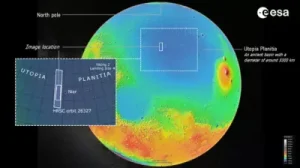
When scientists compared old photographs with newer ones, they began to notice that the dark region had slightly changed its position. The shift was slow. Yet it became obvious after long periods of observation.
Some of the clearest views were later taken by the Mars Express spacecraft operated by the European Space Agency. Those images helped researchers see that the southern edge of the dark area had moved much farther than expected.
What could cause the Dark Region on Mars?
The darker color of the surface is most likely explained by volcanic ash mixed with small pieces of rock. These materials remained after ancient eruptions. Such material looks darker than surrounding dust. That is why the zone stands out clearly in satellite images.
At first, the difference between images seemed small. It almost looked unimportant.
But over decades the change became easier to notice. Measurements suggest that the edge of the dark region has shifted by hundreds of kilometers. This shows that surface processes on Mars are still active, even if they move slowly.
One possible explanation is connected with Martian winds.
Strong winds are common on the planet. They may gradually move ash across the ground. Another possibility suggests the opposite effect. Winds could be blowing away lighter dust and slowly uncovering darker material underneath.
At the moment, scientists do not have enough data to clearly confirm which of these ideas is correct.
Utopia Planitia has been studied for many years. Researchers believe the region may have had contact with water in the distant past. Different missions explored this area to better understand its structure and history.
Scientists are also interested in what may be hidden below the surface. Some research suggests that frozen layers could exist underground in this region. If this assumption is correct, such deposits could be useful for future missions that plan long-term work on Mars.
Because of these unanswered questions, the region continues to attract attention. What looks like a simple dark mark from orbit may eventually help explain how the Martian landscape formed and changed over long periods of time.
We previously reported that scientists have claimed that Saturn’s moon may be habitable. These claims are based on data obtained by the Cassini spacecraft, which collected ice crystal samples from geysers at the moon’s south pole.