Chinese Satellite Breaks Apart, Creating Dangerous Space Debris
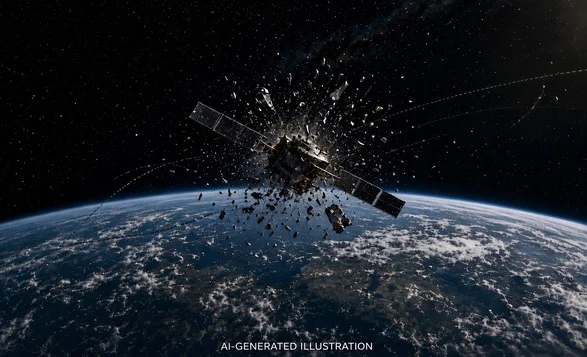
A Chinese satellite has unexpectedly broken apart in one of the more unusual orbits around Earth. The incident has created dozens of new pieces of space debris.
The spacecraft was Yaogan-50 (02), which China launched on March 15, 2026. A Long March 6A rocket carried the satellite into space.
Yaogan-50 (02) reached an altitude of about 952 kilometers, or roughly 590 miles. It was placed into a highly retrograde orbit with an inclination of 142 degrees.
Unlike most satellites in low Earth orbit, the spacecraft traveled in the opposite direction to Earth’s rotation. That unusual trajectory could make future encounters with other objects particularly dangerous.
The satellite operated for only several months before something went wrong. The exact cause of the incident has not been established.
Some of the debris could remain in orbit for thousands of years
On September 4, the U.S. Space Force cataloged at least 43 objects produced by the breakup. Astronomer Jonathan McDowell reported the new debris while tracking the event.
The fragments are now spread across orbital altitudes from about 600 to 1,100 kilometers. They have remained close to the original 142-degree orbital path of the satellite.
That altitude is especially important because Earth’s atmosphere is extremely thin there. Atmospheric drag gradually pulls lower satellites toward Earth, but the effect becomes much weaker at greater heights.
NASA estimates that debris around 800 kilometers can take centuries to leave orbit naturally. Above 1,000 kilometers, some fragments could remain around Earth for thousands of years.
This creates a long-term problem for other spacecraft operating in the same region. A collision with even a relatively small piece of debris can release enormous amounts of energy at orbital velocity.
Scientists do not yet know what destroyed Yaogan-50 (02). A propulsion failure or battery problem could have caused the spacecraft to break apart. A collision with another object is another possibility.
VIDEO. The satellite was launched aboard a Long March 6A rocket in March 2026.
The incident adds to an already growing population of objects surrounding Earth. The European Space Agency has recorded more than 660 explosions, collisions and other fragmentation events.
ESA estimates that the number of space debris objects larger than one centimeter has already exceeded 1.5 million. Many are too small to track individually, yet they can still damage or destroy spacecraft.
China describes the Yaogan-50 series as remote-sensing satellites used for land surveys, crop monitoring and disaster prevention. SpaceNews has reported speculation that the series may also support military reconnaissance and intelligence activities.
The breakup of Yaogan-50 (02) therefore creates more than a temporary cloud of debris. Some of the fragments could remain in orbit long after the satellite itself has been forgotten.
It was previously reported that NASA photographer Joel Kovsky captured a rare and stunning image of the International Space Station crossing the Sun during the solar eclipse of August 12, 2026.