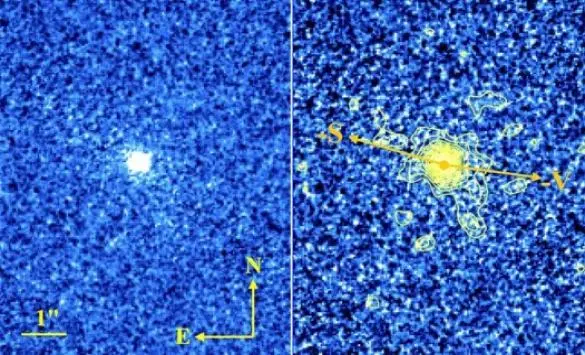
Astronomers searching for signs of alien technology have detected a mysterious radio signal coming from the direction of a distant planetary system. The signal was found in data collected by China’s enormous FAST radio telescope. Researchers recently developed a new method for searching through old observations of 33 planetary systems.
Most of the systems produced nothing unusual. But one signal from the direction of K2-155 immediately stood out. K2-155 is a red dwarf located about 238 light-years from Earth. The star has three known planets, including K2-155d, a super-Earth about 1.6 times the radius of our planet.
Even more interestingly, K2-155d orbits near the star’s habitable zone. This is the region where conditions could potentially allow liquid water to exist on a planet’s surface.

A signal that looked surprisingly unusual
The mysterious signal was given the name NBS 260108. It was detected at a frequency of 1148.4167 MHz. What caught the researchers’ attention was not simply its presence. The signal was extremely narrow and appeared to drift across frequencies.
That combination is particularly interesting in the search for extraterrestrial technology. A transmission from a distant planet could shift in frequency as the planet rotates and moves around its star.
The FAST telescope provided another intriguing detail. Its receiver observes the sky using 19 separate beams. The strange signal appeared in the beam aimed directly toward K2-155. It was not detected by the other 18 beams watching nearby areas of the sky.
Video. NASA Discovers a New Earth Like Exoplanet K2-155d.
Researchers used machine learning and wavelet analysis to search through an enormous amount of radio data. The system initially identified more than 139,000 possible detections. After several rounds of filtering, only two signals remained especially interesting. One had already been associated with interference from Earth. The other was NBS 260108.
For astronomers searching for technosignatures, this made the signal particularly difficult to ignore. It had several characteristics that would make a genuine artificial transmission worth investigating.
There is still a major question, however. Where did the signal actually come from? The researchers noticed that similar signals appeared at nearby frequencies while FAST was observing three other stars. NBS 260108 was also much stronger in only one polarization channel.
Those details could point toward an Earth-based or instrumental source. Yet the researchers have not identified exactly what produced the signal. For now, NBS 260108 remains unexplained.
That leaves open the possibility that astronomers are looking at something far more interesting than ordinary radio interference. Further observations of K2-155 could help determine whether the strange transmission was simply a terrestrial mystery or something originating much farther away. The findings have been published in The Astronomical Journal.
It was previously reported that a NASA photograph of Mars sparked new theories about the existence of alien life. Attentive observers noticed mysterious traces left on the dusty surface of the Red Planet.