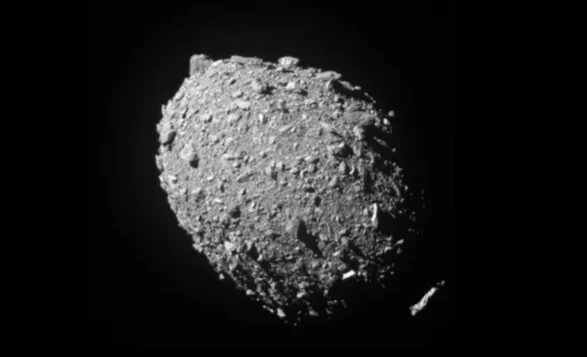
Asteroid Bennu is heading toward Earth with an impact force equal to 22 atomic bombs
Bennu is a dark, carbonaceous near-Earth object belonging to the Apollo group, with a mean radius of roughly 262 meters. Visually, it resembles a massive spinning top.
First discovered in September 1999 by the LINEAR survey project at the Socorro Observatory, the object rapidly caught the attention of astrophysicists due to its complex orbital mechanics.Key physical characteristics shaping Bennu’s orbit include:
- Retrograde rotation: Its rotation axis is tilted at 178° relative to its orbital plane, meaning it spins in the opposite direction of its path around the Sun.
- Six-year cycles: Bennu approaches Earth every six years, subtly shifting its trajectory due to gravitational interactions and thermal radiation pressure (the Yarkovsky effect).
Potential impact date and scale of destruction
According to orbital projections, the most significant potential collision window centers on September 24, 2182. While the overall cumulative impact probability remains low (roughly 1 in 2,700), the potential severity prevents researchers from dismissing the risk.
If Bennu were to strike Earth, the energy release would equal roughly 22 atomic bombs (hundreds of megatons of TNT equivalent). An impact of this magnitude would trigger:
- An impact crater several kilometers wide.
- Complete destruction across regions within hundreds of kilometers of ground zero.
- Widespread atmospheric dust injection, leading to temporary regional or global climate shifts.
OSIRIS-REx and the future of planetary defense
To eliminate guesswork, NASA dispatched a dedicated probe to study the object up close. According to official findings from the NASA OSIRIS-REx mission team, the spacecraft conducted high-resolution mapping and successfully collected pristine surface samples, returning them safely to Earth for lab analysis.
This physical data is pivotal for global planetary defense initiatives. Knowing Bennu’s precise density, structural integrity, and mineral composition allows engineers to model deflection techniques long before a deadline arrives:
- Kinetic impactors: Altering Bennu’s trajectory by crashing a high-mass spacecraft into it (a concept validated by NASA’s DART mission).
- Gravity tractors: Using a spacecraft’s subtle gravitational pull over years to gently nudge the asteroid off a collision course.
While the calculated window is more than a century away, planetary scientists emphasize that testing defense mechanics today is the only way to guarantee safety tomorrow.
Read also: It was previously reported that scientists sounded the alarm over asteroid 2024 YR4, which initially showed a potential risk of impact in 2032 with energy comparable to a nuclear blast.