Ancient Dagger: The Mystery of Tutankhamun’s Alien Steel
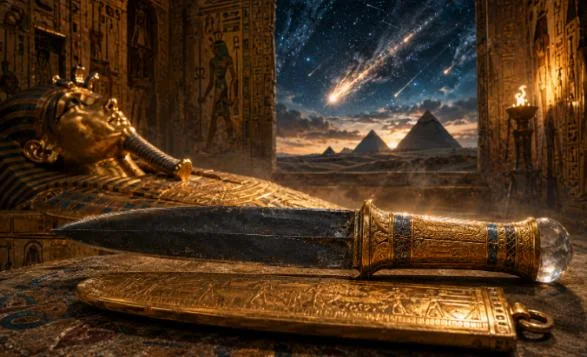
A mysterious dagger from the tomb of Egyptian pharaoh Tutankhamun has fascinated scientists for decades. The ancient weapon survived for more than 3,000 years, and its unusual metal has revealed an extraordinary secret. Researchers discovered that the blade was not made from ordinary iron found on Earth.
Studies suggest that the famous Tutankhamun dagger was forged from extraterrestrial metal. The iron most likely came from a meteorite that fell to Earth thousands of years ago. This makes the weapon one of the most unusual artifacts associated with Ancient Egypt.
The chemical composition of the blade provided important clues. Scientists found high levels of nickel, which are common in iron meteorites. The results strongly support the idea that the ancient weapon was made from meteorite iron.
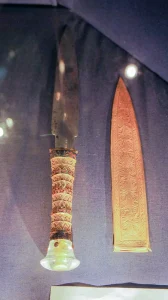
Iron objects were extremely rare in Egypt during this period, making meteorite metal especially valuable. People could also have viewed such material as something that had fallen from the sky.
The dagger was discovered during the examination of Tutankhamun’s mummy in 1925. Experts have studied the artifact for decades, trying to understand its unusual material and the techniques used to create it.
Modern research has provided important clues. Scientists examined detailed photographs and X-ray images of the blade, while chemical analysis helped identify the type of meteorite that most likely supplied its iron.
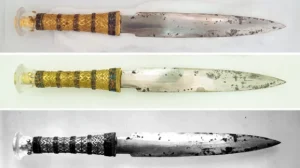
One discovery was particularly important. Researchers identified the Widmanstätten pattern, a distinctive crystal structure found inside many iron meteorites. It develops as iron and nickel crystals slowly form over extremely long periods.
The pattern remained visible on Tutankhamun’s dagger, suggesting that ancient craftsmen used relatively low temperatures when shaping the blade. Researchers estimate that the forging temperature remained below 950 degrees Celsius.
A higher temperature would probably have destroyed the distinctive crystal structure. The craftsmen therefore used a careful technique that preserved the pattern within the meteorite iron.
The discovery offers a fascinating glimpse into ancient knowledge. People thousands of years ago did not understand meteorites through modern science, but they could recognize unusual pieces of metal that arrived from the sky.
The dagger was also more than a practical weapon. Its handle was decorated with gold and other materials, showing that it was a valuable ceremonial object connected with royal status and prestige.
Scientists also examined the material used around the decorative elements. Their analysis suggested the use of lime-based plaster, a technique that was unusual in Egypt during that period.
This detail has led researchers to consider a foreign origin for the dagger. Instead of being manufactured locally, the weapon may have arrived in Egypt as a diplomatic gift from another ancient kingdom.
Researchers have connected the weapon with the ancient Mitanni kingdom, which controlled parts of Anatolia and northern Mesopotamia. Historical records describe diplomatic exchanges between Egyptian rulers and foreign royal families during this period.
One ancient letter mentions an iron dagger with a golden handle that was given to the Egyptian royal family. This connection has strengthened the possibility that Tutankhamun’s dagger came from abroad.
The possible foreign origin is especially interesting because the young pharaoh was buried with many valuable objects. His tomb contained thousands of artifacts that reflected royal wealth, craftsmanship and international connections.
Rare historical footage and photographs show the examination of Tutankhamun’s tomb and mummy.
The meteorite dagger adds another remarkable detail to that collection. Its iron began its history somewhere beyond Earth before eventually becoming part of an Egyptian royal burial.
Tutankhamun became famous after his remarkably preserved tomb was discovered in 1922. The burial chamber revealed an extraordinary collection of artifacts that continues to provide information about Ancient Egyptian culture and technology.
The Tutankhamun dagger is especially fascinating because its story connects archaeology with astronomy. Its extraterrestrial metal shows that materials from space had a place in human history thousands of years ago.
Today, the ancient weapon remains one of the most unusual objects linked to King Tut. Its meteorite iron offers a rare glimpse into ancient technology, international trade and beliefs surrounding materials that came from the sky.
Sources. Tutankhamun Spatial Archive — Dagger and Sheath, Carter 256K — Griffith Institute, University of Oxford. The meteoritic origin of Tutankhamun’s iron dagger blade — Daniela Comelli et al., Meteoritics & Planetary Science.
It was previously reported that scientists are close to uncovering a secret hidden beneath the sealed tomb of China’s first emperor. This 2,000-year-old mystery may finally be solved after scientists discovered mysterious mercury vapor.