World beneath Antarctica reveals 60 million fish nests
Far beneath the frozen waters of Antarctica, scientists have uncovered a breathtaking underwater world that remained hidden for thousands of years.
While exploring the icy depths of the Weddell Sea, researchers discovered an enormous breeding colony containing an estimated 60 million fish nests. The find is now recognized as the largest continuous fish spawning ground ever documented anywhere in the world’s oceans.
The discovery was completely unexpected. Researchers aboard the German icebreaker RV Polarstern were investigating the Antarctic seafloor and mapping the region’s unique marine environment. Their mission was focused on understanding life beneath the permanent ice, not searching for breeding colonies.
To examine the ocean floor, the team deployed the Ocean Floor Observation and Bathymetry System (OFOBS). This underwater camera platform was towed behind the research vessel, sending live video back to the scientists.
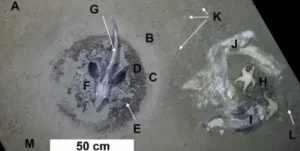
During one of the surveys, PhD student Lillian Beringer noticed thousands of strange circular depressions covering the muddy seabed. At first glance, they looked like mysterious craters.
As the expedition continued, the unusual pattern became impossible to ignore. Every new section of seafloor revealed more of the same formations stretching toward the horizon. Scientists soon realized they had stumbled upon something extraordinary.
Detailed analysis confirmed that the depressions were nests belonging to the Antarctic icefish (Neopagetopsis ionah).
This remarkable species is unlike almost every other vertebrate on Earth because it lacks hemoglobin, the protein that normally carries oxygen through the blood. Instead of red blood, these fish have nearly transparent blood, an adaptation that allows them to survive in the freezing waters surrounding Antarctica.
What the hidden world beneath Antarctica reveals about life under the ice
The breeding colony covers approximately 240 square kilometers (about 93 square miles). Researchers estimate that nearly 60 million nests are scattered across the area. Most nests are occupied by an adult icefish that remains nearby to protect its developing eggs from predators.
Each nest contains an average of around 1,700 eggs. That means the colony could eventually produce tens of billions of young fish during a successful breeding season. Marine biologists say few wildlife nurseries on Earth operate on such an enormous scale.
Scientists from the Alfred Wegener Institute explained that the true significance of the discovery only became clear after thousands of underwater photographs were carefully examined.
They concluded that this is the largest continuous fish breeding colony ever found. The area also contains one of the highest concentrations of fish biomass recorded on the Antarctic seafloor.
The discovery highlights how little researchers still know about the Antarctic ecosystem. Although Antarctica has been studied for decades, vast regions beneath its sea ice remain unexplored.
New technologies are now allowing scientists to investigate environments that were once impossible to reach.
The massive breeding ground also plays a vital role in the region’s food chain. Antarctic icefish provide an important food source for seals, penguins, seabirds, and other marine predators.
Protecting these fragile habitats could become increasingly important as climate change continues to reshape polar ecosystems.
Before leaving the area, the crew of RV Polarstern installed two long-term underwater camera systems near the colony. These cameras will monitor the nests throughout the year without disturbing the fish.
Researchers hope the recordings will reveal how the colony changes over time and how environmental conditions influence breeding success.
Scientists believe discoveries like this are only the beginning. Much of the Antarctic Ocean remains hidden beneath thick ice, and every expedition has the potential to uncover another remarkable ecosystem.
The discovery of these vast fish nests is a reminder that some of Earth’s greatest natural wonders are still waiting beneath the frozen waters of Antarctica.
Source: Daily Galaxy..
Earlier, scientists reportedly sounded the alarm and warned of plant dangers. They warned that thousands of unique flowering plants could disappear forever, taking with them millions of years of evolution.