A NASA telescope is out of control and falling to Earth
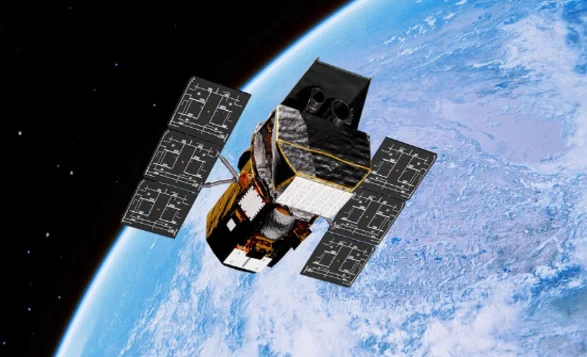
A NASA space telescope that spent more than two decades observing some of the most powerful explosions in the universe is now heading toward its final destination: Earth’s atmosphere. The Neil Gehrels Swift Observatory has lost the ability to maintain its orbit, and scientists expect the 1.5-ton spacecraft to make an uncontrolled return to the planet in the coming days.
The most concerning question is what will happen to the pieces that survive the descent.
According to the Associated Press, the US Space Force expects Swift to reenter the atmosphere around November 6. Most of the spacecraft should burn up during its passage through the atmosphere. However, NASA scientists warn that some particularly dense components could survive. These include parts made of tungsten, a metal considerably denser than lead, as well as sections of the telescope’s mirrors.
Any surviving fragments are most likely to fall into the ocean. Nevertheless, the predicted reentry corridor covers a vast area of the planet. Parts of Africa, Australia, India, Southeast Asia, Central America and South America lie within the possible zone. The exact location of any surviving debris will depend on the spacecraft’s trajectory during its final descent.
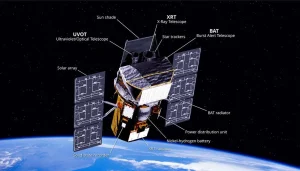
Swift’s decline was accelerated by unusually strong solar activity. Increased energy from the Sun heats and expands Earth’s upper atmosphere, increasing atmospheric drag on satellites in low orbit. As a result, spacecraft lose altitude more rapidly than expected.
NASA had been trying to prevent this outcome. The agency hired Katalyst Space Technologies to develop a special robotic spacecraft called LINK, designed to approach Swift, capture it with robotic arms and push it into a higher orbit.
The rescue attempt began in July 2026, but the operation encountered serious technical problems. LINK experienced difficulties with its propulsion and attitude-control systems, leaving engineers unable to complete the planned maneuver. The rescue spacecraft never managed to get closer than approximately 7 to 9 miles from Swift. LINK itself subsequently fell back into Earth’s atmosphere in September.
Swift continued collecting scientific data after the rescue effort was abandoned. However, its orbit kept deteriorating. On October 20, the observatory conducted its final scientific observation before NASA ended the mission.
Launched on November 20, 2004, Swift was originally designed for just two years of operation. Instead, it remained productive for approximately 22 years, becoming one of NASA’s most important tools for studying gamma-ray bursts, among the most energetic explosions known in the universe.
VIDEO. NASA’s Swift Observatory launch on November 20, 2004.
During its lifetime, the observatory detected more than 2,000 gamma-ray bursts and approximately 1,400 supernovas. Its rapid ability to turn toward newly detected cosmic events also allowed other observatories, including Hubble and James Webb, to investigate these phenomena in greater detail.
Swift’s loss marks the end of an important chapter in space astronomy. Although its instruments will soon be destroyed, the enormous collection of observations it gathered will remain available to researchers. Scientists are now considering how future missions can replace its unique capabilities.
For a spacecraft that was supposed to work for only two years, its final journey is bringing an unexpectedly long scientific legacy to an end.
It was previously reported that NASA specialists released footage of a new lunar crater on the Moon. The crater was formed as a result of the recent impact of the SpaceX Falcon 9 rocket’s booster stage on the lunar surface in 2026.