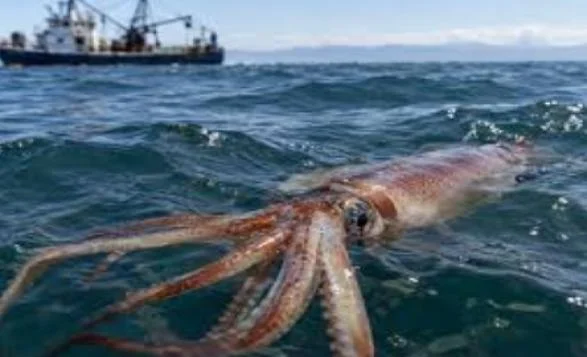
Squid Populations Are Exploding Across the World’s Oceans
Squid populations are expanding in many parts of the world’s oceans. Scientists now believe the explanation is more complicated than climate change alone.
For years, researchers linked the increase in squid populations to warmer seas and declining numbers of large predatory fish. However, new computer simulations suggest that rising ocean temperatures may actually reduce the total biomass of squid.
Researchers created models representing different marine ecosystems. They then tested what happened when large predators disappeared and water temperatures increased.
The removal of large fish caused squid numbers to rise. However, the cephalopods did not fully replace the predators that had disappeared. Their increased numbers also failed to compensate for the lost animal biomass.
The researchers found that food availability may be a much more important factor. When large predatory fish become less common, more smaller fish remain in the ecosystem. These fish can become an additional food source for squid.
Squid have another important advantage. Their metabolism is extremely fast, and some species can consume food equivalent to roughly 30 percent of their body weight each day.
The animals also grow remarkably quickly. Many squid can develop around five times faster than numerous fish species. Their short lifespan, often only one or two years, allows populations to recover rapidly.
This combination makes squid highly adaptable. They can quickly occupy areas affected by overfishing, ocean warming and ecosystem disruption. Their rapid growth may give them an advantage over slower-growing marine animals.
Temperature, however, produces a different effect. In the simulations, warmer water reduced individual squid weight. Higher temperatures increase metabolic demands, while food supplies may not rise fast enough.
The study therefore suggests that climate change and squid population growth are connected in complicated ways. Warmer oceans may help some populations expand while simultaneously reducing their body size.
The researchers stress that their work is still a preprint and has not undergone peer review. The model also excludes several factors, including temperature differences with depth and heat-related effects on squid embryos.
Future research will need to determine whether these results match real-world changes across different oceans. Scientists are particularly interested in how continued ocean warming could reshape marine ecosystems.
Source: ScienceAlert
It was previously reported that the giant killer shark Sharkzilla was attacking seals and whales. Scientists began tracking this enormous predator off the coast of New York to check for nuclear mutations.