NASA Mars Photo Reveals Mysterious Tracks in the Dust
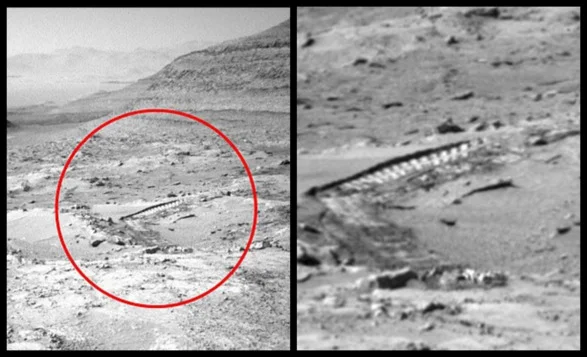
A strange pattern in an old NASA photograph has suddenly attracted fresh attention online. Some viewers believe the markings look remarkably similar to tracks left by a vehicle.
The image was captured by NASA’s Curiosity rover on May 19, 2025. It shows a familiar Martian landscape filled with rocks, dusty ground and distant hills. But one detail in the terrain has now become the center of an unexpected debate.
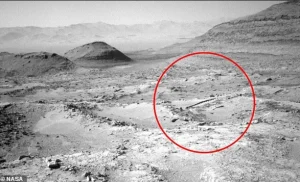
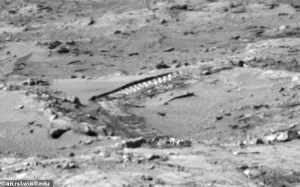
Several markings appear to form a surprisingly regular pattern across the surface. From a distance, they can look like tire impressions running through the Martian soil. That resemblance has led some observers to ask an obvious question: could Curiosity have photographed something moving across the planet?
The image was recently reposted on social media by space enthusiast Kari Sivertzen. She was not claiming to have discovered an alien vehicle. Instead, she highlighted unusual depressions in the landscape that could potentially be connected with ancient water activity or an impact.
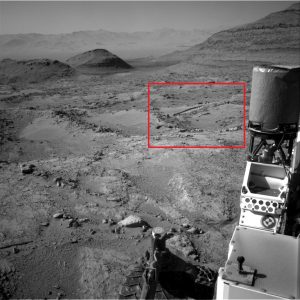
However, other users immediately focused on the apparent tracks. Some pointed out that the pattern does not seem to match Curiosity’s own wheel marks. That comparison became particularly interesting because another image taken only two minutes later appears to show the same formation from a different angle.
NASA’s real rover tracks look very different
Curiosity’s wheels leave distinctive marks in Martian soil. NASA explains that holes in the rover’s six wheels create recognizable patterns in the tracks. Those patterns even contain Morse code representing “JPL,” the Jet Propulsion Laboratory that built and operates the rover.
That makes the mysterious formation intriguing, but it does not automatically make it artificial. Mars is full of geological structures that can appear surprisingly regular when photographed from particular angles.
The planet’s surface has also produced countless examples of apparent objects, faces and structures that later received ordinary geological explanations. The human brain is extremely good at recognizing familiar shapes in ambiguous patterns, a phenomenon known as pareidolia.
There is another reason the photograph has attracted attention. Curiosity has spent years investigating Gale Crater, an ancient environment that once contained streams and lakes. NASA says the rover has found extensive evidence that liquid water existed there billions of years ago.
Curiosity was designed to investigate whether those ancient conditions could have supported microbial life. It was never intended to directly detect living organisms. Instead, the rover studies rocks, minerals and chemical evidence that can reveal whether Mars was once habitable.
The timing of the renewed speculation is also interesting. NASA’s Perseverance rover has already identified a Martian rock sample containing potential biosignatures. Scientists stress that these findings could indicate ancient microbial activity, but non-biological explanations have not been completely eliminated.
So far, there is no evidence that the strange tracks in the Curiosity photograph were made by an alien vehicle. But the image raises an entertaining question about how much could be hiding in plain sight across the Martian landscape.
For now, the mysterious markings remain unexplained in the available imagery. Whether they are geological features, an unusual surface pattern or something else entirely, Mars continues to produce photographs that invite us to look twice.
Source: NASA Science — original image. Daily Mail.
It was previously reported that scientists were exploring a new question: could deep sleep help astronauts survive a mission to Mars? Experts are currently studying cosmonaut hibernation as a means of protecting against radiation and stress.