Mystery of how the Moon formed may finally be solved
The Moon may have formed far faster than scientists once believed. New computer simulations suggest that Earth’s natural satellite could have emerged within only a few hours after a gigantic planetary collision. The finding offers a new perspective on one of the biggest mysteries in planetary science.
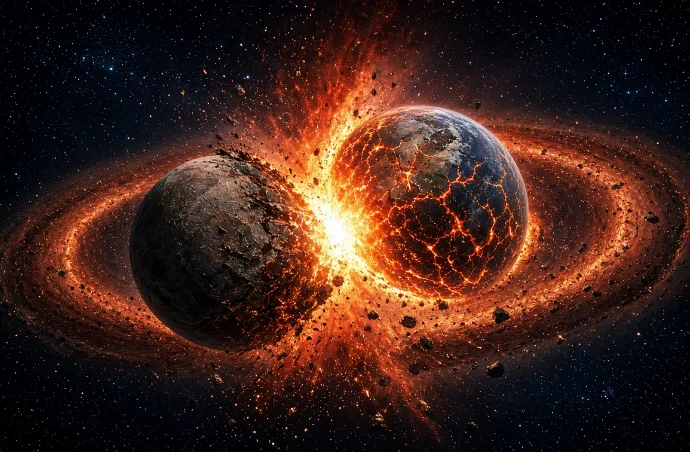
For decades, the leading explanation has been the giant-impact theory. According to this scenario, the young Earth collided with a planet-sized body known as Theia. Theia was probably similar in size to Mars, and the collision released an enormous amount of energy.
The impact would have blasted huge quantities of molten rock and debris into space. Scientists traditionally believed that this material formed a disk around Earth before slowly coming together. Over time, the debris eventually produced the Moon.
Researchers from the Southwest Research Institute and the University of Arizona now suggest that the process may have been much faster. They used advanced computer simulations to recreate different versions of the ancient collision. Their models included an important factor that earlier calculations often overlooked: the strength of planetary rock.
Rock does not behave like a simple fluid during a planetary collision. Its physical strength depends partly on temperature and pressure. Extremely hot material becomes weaker, while cooler rock can withstand much greater forces.
The researchers found that these differences could completely change what happens after an impact. In some simulations, the collision severely disrupted Theia and created a huge disk of molten and fragmented material around Earth. Such a disk could later have supplied the material needed to form the Moon.
But another scenario produced a remarkable result. When the researchers used conditions similar to earlier impact simulations, including comparable internal temperatures for Earth and Theia, a largely intact Moon appeared in orbit around Earth.
VIDEO. SwRI-led study models new scenarios for Moon formation. Southwest Research Institute YouTube channel.
Temperature could have changed the outcome of the impact
This does not prove that the real Moon definitely formed in five hours. The result depends on the starting conditions used by the researchers. Instead, the study shows that extremely rapid lunar formation is physically possible.
The finding also highlights the importance of Earth’s condition at the time of the collision. A hotter planet would have been weaker and easier to deform. A cooler body could have behaved very differently when subjected to the same enormous impact.
This improved approach could help scientists study other cosmic collisions as well. Including the strength of solid materials makes computer models more realistic. The same techniques could be useful when investigating impacts involving asteroids, dwarf planets and other rocky bodies.
The simulations may also provide new clues about the Moon’s unusual characteristics. Scientists have long investigated why lunar material contains relatively little volatile matter. Extreme temperatures during the collision could have influenced how these substances were lost or redistributed.
Another mystery concerns the remarkable chemical similarity between Earth and the Moon. Lunar rocks have isotopic characteristics that closely resemble those found on our planet. This has created difficulties for some versions of the giant-impact theory.
A rapid formation scenario could offer another way to examine this problem. Material from Earth and Theia may have mixed and redistributed differently during the first hours after the collision. The exact outcome would have depended on the temperature, composition and strength of both worlds.
Scientists still do not know exactly what happened after Theia struck Earth. The giant-impact theory remains the leading explanation for the Moon’s origin, but many details are still being debated.
The latest simulations suggest that the most important part of the Moon’s birth may have happened remarkably quickly. Instead of slowly assembling over a long period, our satellite could have taken recognizable form within hours.
Billions of years later, the Moon remains a constant presence in Earth’s sky. Yet its birth may have been decided during one extraordinarily violent event that unfolded in less than a single day.
It was previously reported that NASA specialists released a photo of a new lunar crater. This new crater was formed as a result of the recent impact of the SpaceX Falcon 9 rocket’s booster stage on the lunar surface in 2026.