Scientist Explains What Aliens Might Actually Eat If They Ever Visited Earth
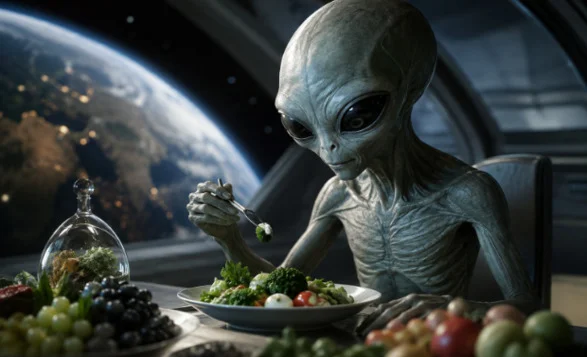
What would happen if an alien civilization suddenly arrived on Earth? One of the first questions might not be about communication or technology, but something much simpler: what would they eat?
According to Professor José Miguel Soriano del Castillo from the University of Valencia, the answer would probably surprise most people. In an article published by The Conversation, the scientist argues that Earth could look less like a giant buffet and more like a dangerous place filled with unfamiliar chemicals and microorganisms.
The professor believes many popular ideas from science fiction are far from realistic. Hollywood often shows friendly aliens enjoying human food or sweets. In reality, extraterrestrial visitors might have no interest in anything we normally eat.
Even if alien life shared certain biological similarities with humans, there would be no guarantee that our food was safe. Proteins, sugars and fats that keep people alive could be impossible for another species to digest. In some cases, they might even be toxic.
Instead of bread, fruit or meat, extraterrestrials could be interested in much simpler materials. Water, nitrogen, phosphorus, iron, mineral salts, lipids, microbial biomass and basic organic molecules may be far more useful than a cooked meal.
VIDEO. NASA Scientist Answers Alien Questions | WIRED.
Earth Could Be a Dangerous Restaurant for Alien Visitors
The scientist says every living organism needs three essential things. It requires a source of energy, chemical elements for building cells and a suitable environment where biological reactions can take place. Earth contains all of these ingredients, making the planet potentially attractive for life from elsewhere in the universe.
Earth is filled with bacteria, viruses, fungi and countless microorganisms that evolved alongside life here. An alien organism with a completely different biology could react to them in unpredictable ways. The same applies to allergens, natural toxins and even oxygen-rich air if its home world developed under different conditions.
Professor Castillo also discussed one of the oldest UFO stories. Some conspiracy theories claim mysterious cattle mutilations are linked to extraterrestrial visitors. While he offers no evidence that such claims are true, he notes that different digestive systems could explain why another species might be interested in studying animals instead of eating ordinary human food.
Researchers admit there is currently no way to predict the exact diet of an alien civilization. Without knowing its chemistry or metabolism, every scenario remains theoretical. Scientists can only compare possible extraterrestrial biology with the incredible diversity already found among living organisms on Earth.
The professor even suggests that highly advanced civilizations may no longer depend on food at all. If they became post-biological beings with artificial or synthetic bodies, their energy could come from electricity, chemical fuel, heat or even compact nuclear power systems instead of traditional nutrition.
If humanity ever establishes direct contact with intelligent extraterrestrials, specialists in biology, chemistry and nutrition may face an entirely new challenge. Before sharing a meal, scientists would first need to understand how an alien body produces energy and what substances it actually requires to survive.
For now, these ideas remain speculative. Still, they highlight an interesting question that rarely appears in discussions about first contact. If aliens ever arrive on Earth, the biggest surprise may not be what they look like, but what they choose to consume.
It was previously reported that archival NASA audio recordings from the 1972 Apollo 16 mission had been released. These recordings sparked controversy after scientists mentioned an alien base on the Moon.