Remains of Noah’s Ark: Researchers Find Underground Corridors and Rooms
The American research group Noah’s Ark Scans is led by Andrew Jones. It announced stunning new data from the Durupınar geological formation in eastern Turkey. The site is just a few kilometers from Mount Ararat.
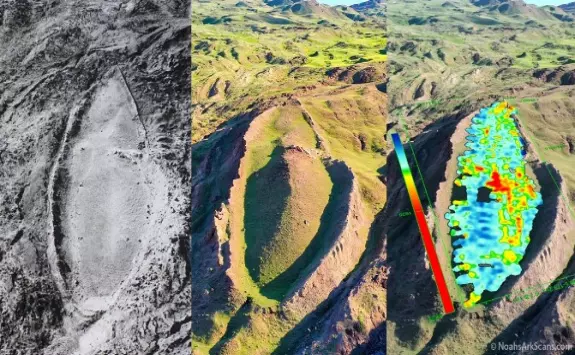
Using state-of-the-art ground-penetrating radar (GPR) and infrared thermography, the scientists discovered an orderly network of underground corridors and rooms. They remarkably accurately match the description of Noah’s Ark’s interior in the Book of Genesis.
According to Andrew Jones, the corridors converge on a large central space. It is the “atrium.” The entire structure has clear right angles and linear forms. These forms are uncharacteristic of natural geological processes.
GPR revealed a network of “corridors” and “rooms” running along the entire boat-shaped formation.
Infrared thermography confirmed the presence of hidden structures. Their temperature and density differ from the surrounding rocks.
Soil analysis revealed that the organic matter content inside the formation is almost three times higher than outside.
Elevated levels of potassium and other markers of wood decomposition suggest the possible remains of an ancient wooden structure.
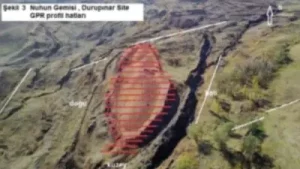
Remains of Noah’s Ark and the Durupınar Formation
The Durupınar Formation was first observed from the air back in 1959. This was by Turkish military engineer Captain İlhan Durupınar. It happened after heavy rains and earthquakes.
Its length is approximately 515 feet (157 meters). Its width and height perfectly match the biblical dimensions. These are “three hundred cubits long, fifty wide, and thirty high” (Genesis 6:15).
Many researchers believe this corresponds to a three-deck ark with compartmentalized “rooms.”
In the 1970s and 1980s, the site was actively studied by American researcher Ron Wyatt. He was the first to claim that it was the actual ark.
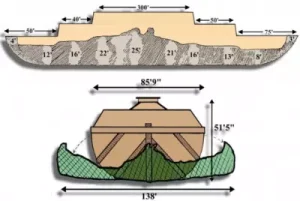
Since then, dozens of expeditions have been conducted here. But only now, thanks to modern technology, have the first real evidence of its artificial origin emerged.
Most professional geologists still believe Durupınar is a natural formation. It is the fossilized “tongue” of an ancient mudflow.
They attribute its boat-like shape to erosion and tectonics. However, even skeptics admit that the new GPR data and soil analysis require serious study.
The Noah’s Ark Scans team itself emphasizes that this is not yet definitive proof. They don’t call the formation an “ark.” Instead, they call it a “potentially man-made structure.”
Plans for the coming years include core drilling and lowering mini-cameras into the discovered cavities. This will allow them to see everything with their own eyes.
The project’s official website, noahsarkscans.com, is already publishing 3D scans, maps, and reports. You can also sign up for tours to the site in 2026 there.
If the hypothesis is confirmed, it will be one of the most significant archaeological discoveries of the 21st century. It will be direct confirmation of the reality of the events described in the Bible.
Source: Noah’s Ark Scans data and Daily Mail publications 2025–2026.
VIDEO. They Finally Entered Noah’s Ark in Turkey — What Was Inside Shocked the World
We previously reported that Italian scientists claimed to have discovered a second Sphinx of Giza. Several prominent media outlets reported that radar scanning had discovered a hidden duplicate of the Sphinx.