ISS Crossed the Sun During the August 2026 Solar Eclipse
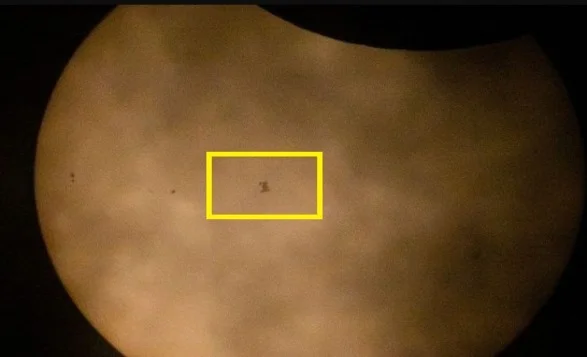
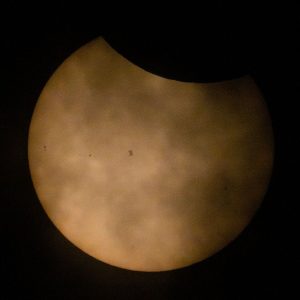
The International Space Station (ISS) became part of a spectacular celestial scene during the solar eclipse on August 12, 2026. NASA photographer Joel Kowsky captured the station as it passed directly across the partially eclipsed Sun near Hodgdon, Maine.
The resulting photograph shows the ISS as a sharply defined silhouette against the bright solar disk. At the same moment, the Moon was covering part of the Sun, creating an unusual combination of two very different objects in a single image.
Although solar eclipses are predictable, photographing the ISS crossing the Sun is considerably more difficult. The space station moves around Earth at roughly 28,000 kilometers per hour, so its passage across the solar disk is extremely brief.
Kowsky had to carefully plan the observation before the eclipse. The photographer needed to be in the correct location, with the camera and telescope already prepared, when the station reached the precise point in its orbit.
The ISS, the Sun, and the observer on Earth all had to line up almost perfectly. A difference of only a few kilometers in the observer’s position could have changed the apparent path of the station and ruined the shot.
A Rare ISS Transit Across the Eclipsed Sun
The photograph was taken in Maine, outside the narrow path of totality. People there witnessed a partial solar eclipse, with the Moon covering only part of the solar disk. Thin clouds also appeared in the sky, adding another layer to the unusual image.
The August 12 eclipse was much more dramatic in areas located along the path of totality. The Moon completely covered the Sun in parts of Greenland, Iceland, northern Russia, the Atlantic Ocean, Spain, and Portugal.
Video: Spanish skateboarder Danny Leon (Instagram) timed his jump perfectly and landed a trick right in front of a total solar eclipse.
For observers in those regions, daylight briefly became noticeably darker as the Moon passed directly between Earth and the Sun. The event attracted photographers, astronomers, and millions of skywatchers.
The International Space Station added another fascinating element to the eclipse. The orbiting laboratory was hundreds of kilometers above Earth while the Moon was nearly 384,000 kilometers away. The Sun, meanwhile, was approximately 150 million kilometers from our planet.
Putting all three objects into one photograph required an extraordinary combination of planning and timing. The ISS was visible against the Sun for only a tiny fraction of the eclipse, making the opportunity especially valuable for an experienced photographer.
Solar transits involving the ISS happen occasionally, but they are normally difficult enough to photograph without an eclipse. The addition of the Moon makes such an image considerably more unusual.
NASA included Kowsky’s photograph in its coverage of the 2026 solar eclipse. The agency also documented the total eclipse from several locations and supported scientific observations of the Sun and Earth’s atmosphere.
For scientists, an eclipse provides a valuable opportunity to study the solar corona and changes in Earth’s atmosphere. For photographers, however, moments like this demonstrate just how spectacular ordinary orbital mechanics can become when everything lines up perfectly.
The image of the ISS crossing the eclipsed Sun is therefore more than an impressive photograph. It captures a fleeting moment when a human-made spacecraft, the Moon, and the Sun appeared together from a carefully selected point on Earth.
Photo: NASA/Joel Kowsky.
It was previously reported that a NASA photograph taken near the International Space Station sparked controversy over UFOs. This came after one researcher claimed that the image showed a giant rectangular spacecraft.