Noah’s Ark May Have Been Found in Turkey: New Underground Clues Emerge
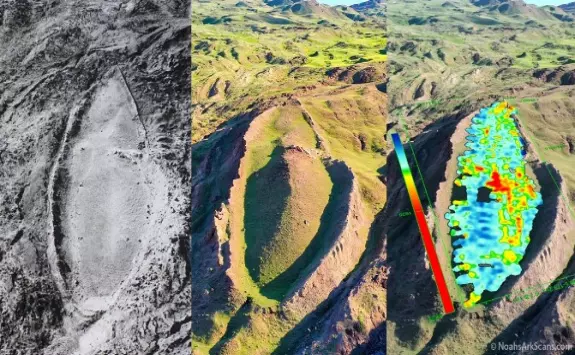
Researchers studying a mysterious boat-shaped formation in eastern Turkey have uncovered new evidence beneath its surface. Soil analysis and ground-penetrating radar have identified several unusual features that could point to buried organic material, although no remains of Noah’s Ark have been conclusively identified.
The investigation is focused on the Durupinar Formation, a geological site located near Mount Ararat. The unusual formation has attracted researchers and explorers for decades because its elongated shape resembles a massive ship.
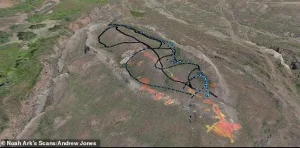
An international research team has collected hundreds of samples from the area and examined the chemical composition of the soil. The results revealed differences between material inside the formation and samples taken from surrounding ground.
According to the researchers, soil inside the formation contains significantly higher levels of carbon than nearby samples. The difference could indicate a greater concentration of organic material beneath the surface.
Archaeologist Jenker Atila suggested that the findings could be consistent with decomposed wood or other organic remains. However, the researchers have not recovered any actual pieces of ancient timber from the site.
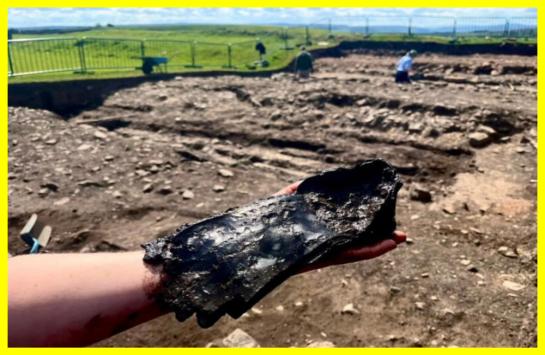
Possible petrified wood identified at Noah’s Ark:
Last week, we ran a visual scan test through one of our partner’s apps. The app was able to identify Limestone and other types of rocks that we have already confirmed to be accurate through past testing.
But one of the rocks… pic.twitter.com/LjMqyWWMqk
— Noahs Ark Scans (@noahsarkscans) September 1, 2026
Radar reveals unusual structures beneath the formation
Ground-penetrating radar has provided another reason for the team to continue investigating the site. The scans detected several underground anomalies at different depths.
Some of the radar signals appear to form relatively straight lines that intersect at angles. Researchers believe these patterns could represent underground voids, layers or other structures. They caution, however, that radar images alone cannot determine whether such features were created by humans or by natural geological processes.
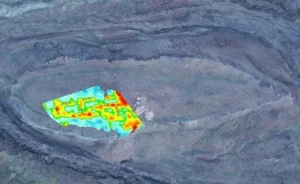
The composition of the soil has also attracted attention. Researchers reported lower alkalinity and increased amounts of organic material and potassium inside parts of the formation. They believe these characteristics could potentially be associated with the long-term decomposition of organic material.
The team has reportedly collected around 1,000 soil samples as part of the continuing Noah’s Ark research. Scientists plan to carry out core drilling to obtain material from deeper underground and determine what is actually responsible for the anomalies.
The Durupinar Formation was identified in aerial imagery in 1959. It is located roughly 29 kilometers south of Mount Ararat and measures about 157 meters in length. Its unusual dimensions have contributed to claims that the formation could correspond to the biblical Ark.
The connection with Noah’s Ark comes from the Book of Genesis, which describes a huge vessel built by Noah before a catastrophic flood. The biblical account says the Ark eventually came to rest in the mountains of Ararat.
For decades, explorers have searched the region around Mount Ararat for physical evidence that could support the story. The Durupinar Formation became one of the most prominent locations associated with these searches because of its distinctive ship-like appearance.
VIDEO. Science CONFIRMS Noah’s Ark and the Flood.
Despite the latest findings, there is still no archaeological proof that the formation contains Noah’s Ark. Most geologists regard Durupinar as a naturally formed geological structure rather than the remains of an ancient vessel.
The researchers also acknowledge that the current evidence cannot establish the origin of the underground anomalies. Higher carbon levels, soil chemistry and radar reflections can have several possible explanations that are unrelated to an ancient ship.
Core drilling could provide more decisive information by revealing the material beneath the surface. Until those samples are analyzed, the Durupinar Formation remains an intriguing geological mystery rather than confirmed evidence of Noah’s Ark.
Source: Daily Mail.
It was previously reported that scientists announced the possible discovery of the true burial site of Jesus after 2,000 years, as archaeologists discovered a hidden site that corresponds to the biblical narrative.