Nearby Super-Earth GJ 3378b May Be More Earth-Like
A nearby planet that has attracted astronomers for years may be far more similar to Earth than previously believed.
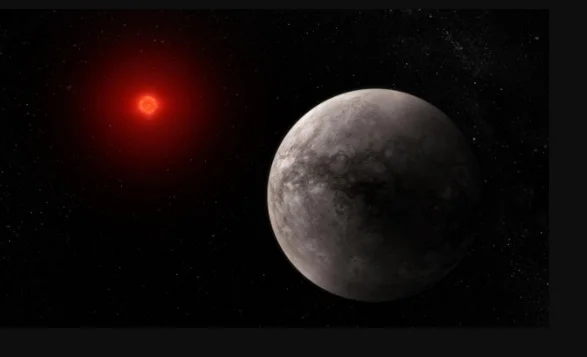
New research suggests that GJ 3378b, located just 25 light-years away, is lighter than earlier estimates indicated. That makes it one of the closest rocky planets found inside a habitable zone.
The study was published in The Astrophysical Journal by Paul Robertson from the University of California, Irvine, and Michael Endl of the University of Texas at Austin. Their analysis changes how scientists view this nearby world.
Earlier observations suggested that GJ 3378b had a mass of about 5.3 times that of Earth. At that size, many researchers believed the planet was likely rich in gas.
The new calculations tell a different story. They place its mass at only 2.3 Earth masses, making it much more likely to be a rocky super-Earth.
That change is important because rocky planets are considered better candidates in the search for life. Although GJ 3378b is larger than Earth, it is still far smaller than Neptune or the giant gas planets found elsewhere in the Solar System.
Video. GJ 3378 b Could Host Life Just 25 Light-Years Away.
Why GJ 3378b Has Become an Exciting Target for Astronomers
Scientists reached the updated estimate using the radial velocity method. Instead of photographing the planet directly, they measured tiny movements of its parent star.
Every orbit creates a small gravitational pull that makes the star wobble. Those movements reveal the planet’s true mass with much greater accuracy.
GJ 3378b completes one orbit every 21.45 Earth days. That may sound like a very short year. However, its parent star is a cool red dwarf rather than a Sun-like star. Because red dwarfs produce much less energy, the planet receives about 90 percent of the radiation Earth gets from the Sun.
These conditions place the planet inside the star’s habitable zone. If GJ 3378b has a stable atmosphere, temperatures could allow liquid water to exist on its surface.
Liquid water remains one of the most important signs scientists look for when evaluating potentially habitable planets. There is still one major mystery. Nobody knows whether the planet has managed to keep its atmosphere over billions of years.
Red dwarfs often produce powerful ultraviolet and X-ray flares. Continuous exposure to this radiation can gradually strip atmospheric gases away and leave a planet exposed.
Even with that uncertainty, GJ 3378b stands out as one of the most promising nearby exoplanets discovered so far. Its relatively short distance from Earth allows astronomers to study it in far greater detail than many other rocky worlds located hundreds of light-years away.
Researchers are now preparing for future observations with the James Webb Space Telescope. They hope its sensitive instruments will detect gases such as water vapor, carbon dioxide, methane, or oxygen.
Those measurements could reveal whether the planet has an atmosphere capable of supporting conditions suitable for life. No evidence of life has been found on GJ 3378b. Still, every new observation brings scientists closer to understanding whether Earth-like planets are common in our galaxy.
If future studies confirm the presence of a stable atmosphere, this nearby super-Earth could become one of the most important targets in the ongoing search for life beyond our Solar System.
We previously reported that world-renowned researchers had solved the mystery of an ancient solar eclipse. This mysterious eclipse occurred in ancient China in 709 BC.