Ink imprints helped scientists restore an ancient Gospel
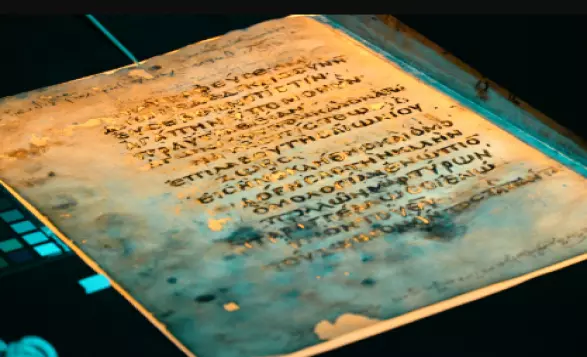
An international group of scientists has managed to restore 42 pages that were long believed to be lost from Codex H (GA 015), one of the oldest surviving Greek manuscripts of the New Testament. Scholars believe the manuscript dates back to the sixth century.
For a long time, Codex H was considered completely lost. Later, researchers found evidence that the manuscript had actually been taken apart in the 13th century at Mount Athos. According to reports cited by Phys.org, the parchment sheets did not disappear—they were simply reused.
This was common practice at the time. The original writing was covered with new text, and some fragments were even used as binding material in other books. Over the centuries, pieces of the manuscript ended up scattered across libraries and collections in Italy, Greece, Russia, Ukraine, and France.
Breakthrough in restoring the ancient Gospel
The real turning point came after Professor Garrick Allen of the University of Glasgow suggested trying a different approach. Instead of looking only at visible text, he proposed searching for faint ink imprints—sometimes called offsets—left when ink transfers from one sheet to another.
These traces are extremely difficult to see with the naked eye. However, specialists were able to capture them using multispectral imaging, a technology that reveals hidden layers on old parchment. In some cases, even one surviving sheet helped researchers recover details from several original pages.

To make sure the findings were genuine, the team carried out radiocarbon dating together with specialists in France. The results confirmed that the parchment most likely dates to the sixth century.
The restored material includes passages from the Epistles of Paul that are already known to scholars. Still, the reconstruction provided additional information about how early versions of the New Testament were structured.
Researchers also noticed ancient chapter lists for the Pauline Epistles that differ from those used today. In addition, they identified signs of scribal work typical of that period, including unusual spelling patterns and layout features.
The condition of the manuscript clearly shows how parchment was often reused in medieval times. This process, known as creating palimpsests, allowed valuable materials to be recycled, although earlier texts were frequently lost as a result.
According to the research team, the project shows how modern technology can help recover texts that were once believed to be gone forever. A digital version of the reconstructed Codex H is now available online for scholars and anyone interested in ancient manuscripts.
VIDEO. The Stichometry of Codex H: Making Sense of Sense-Lines (Emanuele Scieri)
We previously reported that, after many decades, scientists have finally solved one of the long-standing mysteries of Shakespeare’s biography. They have pinpointed the location of the only house William Shakespeare ever owned in London.