Three cosmic events will transform the August 2026 sky as eclipse, meteor shower and planets align
August 12, 2026, could become one of the most interesting dates for astronomy enthusiasts around the world. On this day, observers will have a chance to witness several different space phenomena occurring within the same period.
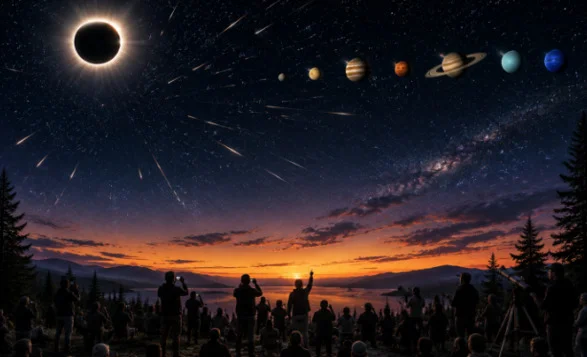
The sky will feature a total solar eclipse, the annual peak of the Perseid meteor shower, and a rare gathering of six planets visible before sunrise. The unusual combination has already attracted attention from millions of people online.
Some social media users have turned the event into a source of jokes and speculation. Comments about a “cosmic reset” and dramatic changes on Earth have spread widely. Scientists, however, say there is no connection between these events and any possible disaster.
Astronomers explain that the three phenomena are created by separate movements in space. The eclipse involves the Moon and the Sun, the meteor shower is caused by comet debris, and the planetary display is the result of Earth’s viewing position.
The first major event will be a total solar eclipse. During this phenomenon, the Moon will appear to move across the face of the Sun and temporarily block its light for people located in the correct viewing area.
The narrow path where the eclipse will be total will pass through Greenland, Iceland, Spain, and Portugal. People inside this region will experience a short period of darkness during the daytime.
Western Iceland and parts of northern Spain are expected to offer some of the best locations for observation. During totality, viewers may see the Sun’s outer atmosphere, known as the corona, surrounding the dark silhouette of the Moon.
Outside the main eclipse path, people in other regions will only see a partial solar eclipse. Experts remind observers that special protective equipment is necessary because looking directly at the Sun can permanently damage eyesight.
VIDEO. Solar Eclipse, Perseid Meteor Shower, Six Planet Parade on August 12.
Perseid meteor shower and six planets will create a spectacular celestial display
The same period will bring another impressive astronomical event — the peak of the Perseid meteor shower 2026. This annual display is one of the most popular meteor showers because it can be seen without professional equipment.
The Perseids appear when Earth travels through a stream of small particles left behind by comet Swift-Tuttle. As the debris enters the atmosphere at high speed, it burns and creates bright flashes known as shooting stars.
During the strongest activity, observers away from city lights may see dozens of meteors crossing the sky every hour. Under excellent conditions, the number of visible meteors could reach around 100 per hour.
The best time to watch the meteor shower will be during the hours before sunrise. A darker sky will improve visibility and allow more faint meteors to become visible.
The final part of the August sky spectacle will be a planetary parade involving Mercury, Jupiter, Mars, Saturn, Uranus, and Neptune. These six planets will appear across the morning sky from Earth’s perspective.
Some planets will be easier to find than others. Mars and Saturn should be visible with the naked eye, while Mercury and Jupiter may be harder to observe because they will stay close to the horizon.
Uranus will likely require binoculars, and Neptune will need a telescope. Although many people describe such events as a “planet alignment”, scientists explain that the planets are not actually forming a straight line in space.
Throughout history, unusual events in the sky have often inspired myths and fears. Ancient civilizations sometimes believed eclipses and strange planetary movements were signs of major events or warnings from the heavens.
Modern astronomy has changed the way people understand these phenomena. Scientists can now accurately calculate eclipses, meteor showers, and planetary movements using advanced observations and mathematical models.
The combination of a total solar eclipse, the Perseid meteor shower, and a six-planet alignment could become one of the most memorable astronomy events of the decade.
Sources NASA Science — Total Solar Eclipse on August 12, 2026:https://science.nasa.gov/eclipses/future-eclipses/total-solar-eclipse-on-august-12-2026. NASA Science — Perseids Meteor https://science.nasa.gov/solar-system/meteors-meteorites/perseids/
It was previously reported that scientists had calculated the exact date of the end of the world on Earth. Experts claim that the main cause of the end of the world on Earth could be a lack of air on the planet.